Sterile Water vs Saline for Peptide Reconstitution?
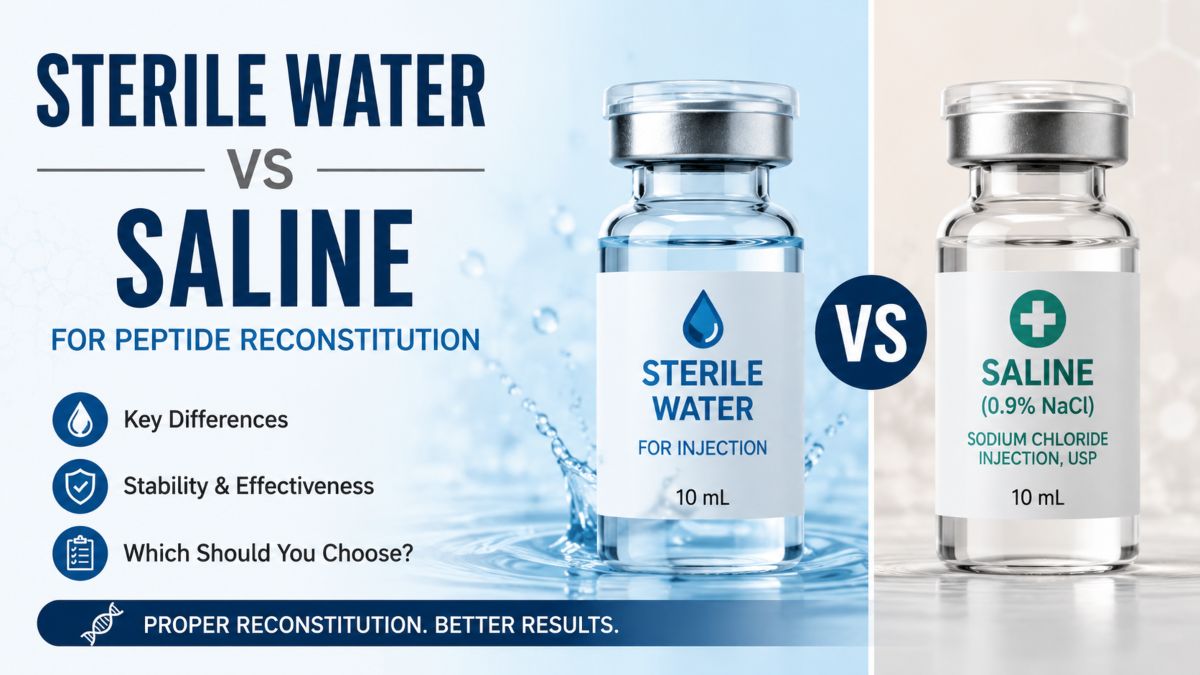
When selecting a reconstitution solvent for peptide research, sterile water and normal saline are the two most common aqueous options and the choice between them is not arbitrary. Each solvent carries distinct chemical properties that can influence peptide solubility, structural stability, and the integrity of a research preparation over time. Sterile water is pure H₂O that has been processed to eliminate microbial contamination, with no added solutes and a near-neutral pH. Normal saline or 0.9% sodium chloride solution is isotonic, meaning its ionic concentration approximates that of physiological fluids. That single difference in composition is what drives most of the variation researchers observe between the two solvents in laboratory settings.
A 2021 review published in the Journal of Pharmaceutical Sciences noted that solvent selection is among the primary variables affecting peptide aggregation behavior during reconstitution, underscoring the importance of carefully examining the Sterile Water vs Saline for Peptide Reconstitution question before designing a reconstitution protocol. For a broader orientation to the reconstitution process, the how to reconstitute peptides guide covers the foundational steps researchers follow across peptide classes. The sections below break down both solvents along the dimensions that matter most in research contexts: pH, osmolality, ionic interactions, stability implications, and the scenarios in which each is most commonly selected. All content here is provided for research and educational purposes only.
What Is the Difference Between Sterile Water and Saline?
The core difference between sterile water and saline is composition: sterile water contains no dissolved solutes, while saline contains sodium chloride at a defined concentration. In peptide reconstitution research, that distinction translates directly into differences in pH, osmolality, and ionic environment each of which can affect how a peptide behaves in solution.
What Is Sterile Water?
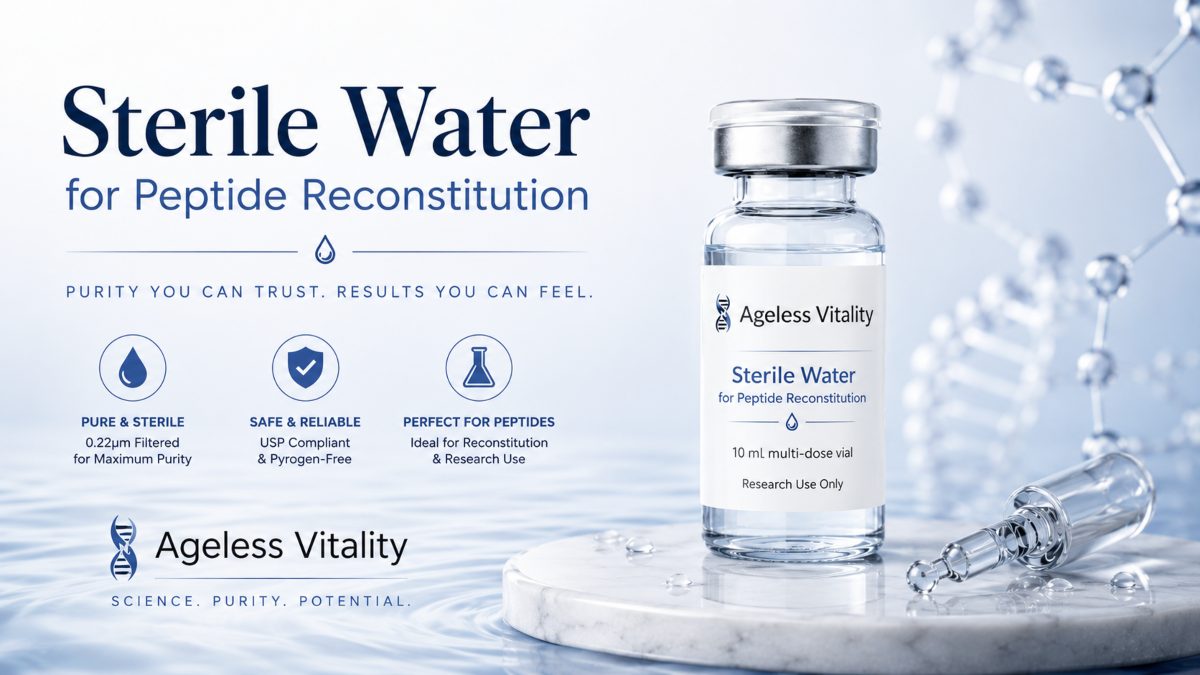
Sterile water is purified water that has been processed typically through filtration, distillation, or autoclaving to eliminate microbial contamination, pyrogens, and particulate matter. It contains no added ions, buffers, or preservatives, leaving it chemically inert relative to most solutes. Its pH ranges from 5.0 to 7.0 depending on dissolved carbon dioxide, and its osmolality is effectively zero, making it hypotonic by definition. In research settings, sterile water is selected when investigators require a solvent baseline free of ionic interference particularly when working with peptides sensitive to salt-induced aggregation or charge interactions at the molecular level. Researchers looking for a dedicated single-use aqueous option will find more detail on the sterile water for peptide reconstitution.
What Is Normal Saline?
Normal saline is a 0.9% aqueous solution of sodium chloride (NaCl). It is classified as isotonic because its osmolality approximately 308 mOsm/kg closely mirrors that of human plasma, which ranges from 275 to 295 mOsm/kg. Its pH typically falls between 4.5 and 7.0, influenced by dissolved CO₂ and trace amounts of acidic byproducts from the sterilization process. The sodium and chloride ions present in normal saline give it measurable ionic strength, which distinguishes it from sterile water in ways that matter when researchers are evaluating solubility behavior, electrostatic interactions, or the conformational stability of charged peptide sequences.
Key Chemical Differences at a Glance
| Property | Sterile Water | Normal Saline (0.9% NaCl) |
|---|---|---|
| Composition | Pure H₂O, no solutes | 9 g NaCl per 1,000 mL H₂O |
| pH Range | 5.0–7.0 | 4.5–7.0 |
| Osmolality | ~0 mOsm/kg (hypotonic) | ~308 mOsm/kg (isotonic) |
| Ionic Strength | None | Low to moderate |
| Preservatives | None | None (standard formulation) |
The practical implication is straightforward: sterile water offers a blank chemical canvas, while normal saline introduces a controlled ionic environment. Neither is universally superior the appropriate choice depends on the peptide’s physicochemical profile and the demands of the specific research protocol.
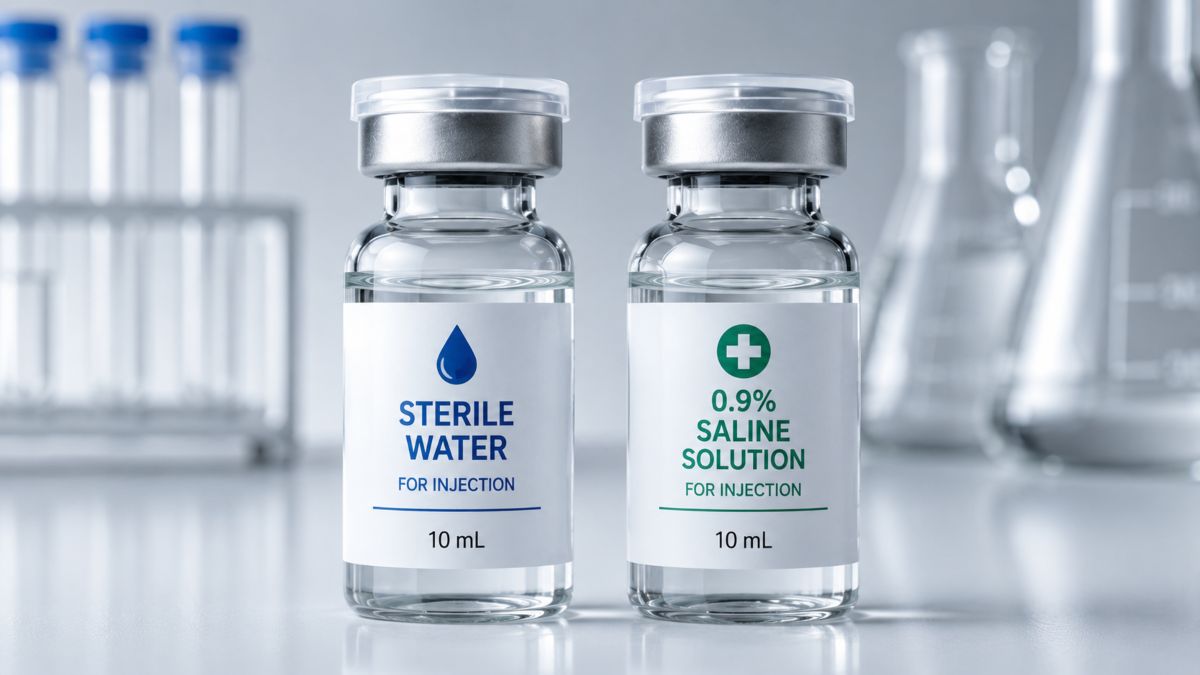
Why Solvent Choice Matters in Peptide Reconstitution
The solvent used to reconstitute a peptide is not a passive carrier it is an active chemical environment that directly influences how the peptide dissolves, folds, and remains stable over time. In research applications, selecting the wrong aqueous solvent can result in incomplete dissolution, accelerated degradation, or aggregation, compromising the integrity of the entire preparation.
How Solvents Affect Peptide Solubility
The balance between hydrophilic and hydrophobic regions along the amino acid sequence governs peptide solubility. Aqueous solvents support solubility by surrounding polar residues with water molecules, but the chemical composition of that aqueous environment modulates how effectively dissolution occurs. Sterile water, being free of competing solutes, allows the peptide’s own charge characteristics to drive dissolution. Saline introduces sodium and chloride ions that can compete for solvation interactions, thereby enhancing or reducing the apparent solubility of the peptide, depending on its net charge and sequence hydrophobicity.
Research has consistently shown that highly hydrophobic peptides those with extended nonpolar sequences tend to require additional solubilization strategies regardless of the aqueous solvent selected, while charged or amphipathic peptides often dissolve readily in either sterile water or saline under appropriate conditions. Peptides such as BPC-157 and TB-500 are among the most widely studied examples of charged research peptides, in which the solvent environment is a documented variable in reconstitution outcomes.
pH and Its Role in Peptide Stability
pH is among the most critical variables in peptide reconstitution research. Every peptide has an isoelectric point the pH at which its net charge is zero and solubility typically decreases as the solution pH approaches that point. At the isoelectric point, reduced electrostatic repulsion between peptide molecules increases the likelihood of aggregation and precipitation. Both sterile water and normal saline can exhibit pH variability depending on absorbed atmospheric CO₂ and manufacturing process.
A 2019 analysis in Biotechnology Progress noted that even modest pH shifts of 0.5 to 1.0 units during reconstitution can measurably alter aggregation kinetics in short peptide sequences. This is why researchers working with pH-sensitive peptides often monitor the reconstitution pH directly rather than relying solely on solvent labeling.
Osmolality Considerations in Research Applications
Osmolality describes the concentration of solute particles in a solution and determines whether that solution is hypotonic, isotonic, or hypertonic relative to a reference fluid. Sterile water is hypotonic at effectively zero osmolality, while normal saline sits at approximately 308 mOsm/kg within the isotonic range. In cell-based or membrane-interaction research, osmolality of the reconstitution solvent can influence experimental outcomes if the peptide preparation comes into contact with biological materials. Hypotonic environments created by sterile water can cause osmotic stress on cellular systems, while the isotonic profile of normal saline more closely approximates physiological conditions. Researchers designing protocols where osmotic compatibility is a variable often factor this directly into solvent selection.
Ionic Strength and Peptide-Solvent Interactions
Ionic strength refers to the total concentration of ions in a solution and has a measurable effect on electrostatic interactions between charged molecules. Sterile water has no ionic strength; normal saline carries a low-to-moderate ionic strength driven by its 0.9% NaCl content. For peptides with significant net charge either strongly cationic or anionic at a given pH ionic strength can modulate the electrostatic repulsion that keeps individual peptide molecules separated in solution.
At low ionic strength, like that found in sterile water, charged peptides tend to repel one another more strongly, which generally supports solubility. At higher ionic strength, like that introduced by saline, those repulsive forces are partially screened by counterions a phenomenon known as the salting-in or salting-out effect depending on the concentration range and peptide characteristics. Understanding where a specific peptide falls on that spectrum is a meaningful input into the selection of reconstitution solvents in research design.
Sterile Water for Peptide Reconstitution Research Profile
Sterile water is one of the most widely used reconstitution solvents in peptide research, valued for its chemical neutrality and compatibility with a broad range of peptide classes. Its absence of ions, buffers, and preservatives makes it a clean baseline solvent one that introduces no competing chemistry into the reconstitution environment.
Advantages of Sterile Water as a Reconstitution Solvent
The primary advantage of sterile water in peptide reconstitution research is its ionic inertness. Because it contains no dissolved salts or charged species, it does not interfere with the electrostatic properties of the peptide being dissolved. This makes it particularly well-suited for charged peptides where ionic screening the partial neutralization of charge by counterions could reduce solubility or promote aggregation. Sterile water also offers formulation flexibility. Researchers who need to adjust pH, add co-solvents such as acetic acid or DMSO, or prepare custom buffer systems often begin with sterile water as the solvent base precisely because it arrives chemically uncommitted.
Starting from a zero-ionic-strength baseline gives investigators full control over the final solution environment rather than working against a pre-existing ionic background. Stability is another consideration. For lyophilized peptides stored as dry powders, sterile water reconstitution minimizes the introduction of reactive species that could accelerate oxidation or hydrolysis at sensitive residues a meaningful factor when working with methionine- or cysteine-containing sequences, which are among the most oxidation-prone amino acids found in synthetic peptides. Peptides such as GHK-Cu and Epithalon, which are frequently studied for their oxidation-sensitive structural properties, are commonly reconstituted in sterile water across the published literature for this reason.
Limitations and Considerations
Sterile water’s hypotonic character is its most significant limitation in certain research contexts. At zero osmolality, it creates a substantial osmotic gradient relative to any biological material it contacts, which can be a relevant variable in assays involving cell membranes, tissue preparations, or osmotically sensitive systems. Solubility is not guaranteed by solvent purity alone. Hydrophobic peptides those dominated by nonpolar residues such as leucine, valine, isoleucine, or phenylalanine often require additional solubilization strategies regardless of aqueous solvent. In these cases, researchers typically introduce small volumes of organic co-solvents or dilute acid before bringing the peptide to finalvolume with sterile water.
A 2020 technical review in Journal of Peptide Science noted that approximately 30% of synthetic peptides require co-solvent assistance to achieve complete dissolution in purely aqueous systems, underscoring that solvent choice is one variable among several in a complete reconstitution strategy. pH drift is also worth noting. Sterile water can absorb atmospheric CO₂ over time, gradually acidifying to a pH as low as 5.5. For long reconstitution workflows or preparations that remain open to ambient air, this shift can become a relevant stability variable depending on the peptide’s isoelectric point.
Which Peptide Classes Are Commonly Reconstituted in Sterile Water in Research
Across the published research literature, sterile water appears most frequently as the reconstitution solvent of choice for hydrophilic peptides, carry a net charge at near-neutral pH, or require a chemically undefined solvent baseline for downstream formulation work. Cationic peptides those with a positive net charge driven by arginine, lysine, or histidine residues tend to dissolve readily in sterile water. The absence of competing anions means the peptide’s own charge-driven hydration is unimpeded. Anionic peptides containing glutamic acid or aspartic acid clusters similarly benefit from the low-interference environment sterile water provides.
Growth hormone-related peptides, melanocortin peptides, and many shorter research peptides of fewer than 20 amino acids are frequently reconstituted in sterile water in laboratory settings. Sermorelin, CJC-1295 + Ipamorelin Blend, and Tesamorelin are among the growth hormone-related peptides most frequently appearing alongside sterile water reconstitution protocols in the research literature. The sterile water baseline also remains the standard starting point in protocols that call for serial dilution or addition of stabilizing excipients after initial reconstitution.
Normal Saline for Peptide Reconstitution Research Profile
Normal saline a 0.9% sodium chloride solution is the second most commonly used aqueous solvent in peptide reconstitution research, selected primarily when isotonic conditions are a relevant experimental variable. Its well-characterized ionic profile and broad availability make it a practical baseline solvent for research protocols where osmotic compatibility matters.
Advantages of Isotonic Saline in Reconstitution Research
The defining advantage of normal saline in reconstitution research is its isotonicity. At approximately 308 mOsm/kg, its osmolality closely mirrors that of mammalian extracellular fluid, making it the solvent of choice in research designs where the peptide preparation will interact with biological systems sensitive to osmotic stress. Cell viability assays, membrane permeability studies, and ex vivo tissue preparations are among the contexts where researchers consistently favor isotonic conditions to minimize osmotic artifacts in their data. Saline also offers practical stability benefits for certain peptide classes.
The ionic environment it creates can suppress ionization-driven aggregation in peptides with low net charge at physiological pH a phenomenon sometimes referred to as the salting-in effect at low ionic strength. For peptides that sit near their isoelectric point in pure water, the introduction of a controlled ionic background via saline can paradoxically improve apparent solubility by modifying the electrostatic landscape around the peptide molecule. Reproducibility is a further consideration. Normal saline is a rigorously standardized formulation with tightly controlled NaCl concentration and osmolality specifications, which supports inter-experiment consistency in research programs where solvent-to-solvent variability needs to be minimized across preparation batches.
Limitations: When Ionic Interference Becomes a Factor
The same ionic character that makes saline advantageous in some research contexts becomes a liability in others. For peptides carrying a strong net charge particularly highly cationic sequences the sodium and chloride ions in normal saline can screen electrostatic repulsion between peptide molecules, reducing the charge-driven solubility that keeps them dispersed in solution. This ionic screening effect can accelerate aggregation, particularly at higher peptide concentrations or during extended storage. Saline is also a poor choice as a reconstitution solvent when downstream analytical techniques are sensitive to ionic background. Mass spectrometry, for instance, is significantly impaired by sodium and chloride ion adducts, which suppress ionization efficiency and complicate spectral interpretation.
A widely cited limitation in proteomics workflows is that even low nanomolar salt contamination can reduce MS signal intensity by 40 to 60 percent, making saline-reconstituted preparations unsuitable for direct MS analysis without desalting steps. Researchers working with disulfide-bridged peptides or those containing oxidation-sensitive residues should also note that saline’s ionic environment can subtly influence redox equilibria in solution, particularly over longer storage periods. While this effect is modest under standard laboratory conditions, it is a variable that careful experimental design accounts for when evaluating long-term peptide stability. Peptides such as MOTS-c and Thymosin Alpha-1, which are studied for mitochondrial and immune-related research, respectively, are examples in which researchers frequently evaluate oxidative stability variables alongside solvent selection.
Research Contexts Where Saline Is Commonly Selected
Normal saline appears most consistently in the research literature as a reconstitution solvent when physiological relevance, osmotic compatibility, or isotonic delivery conditions are specified in the experimental design. Cell-based research assays including receptor-binding studies, internalization experiments, and functional activity screens frequently require saline-reconstituted peptide preparations to avoid osmotic disruption of the cellular systems under observation. Similarly, ex vivo organ bath preparations and tissue perfusion models typically require isotonic solvent conditions throughout, making saline a logical reconstitution choice when the peptide will be introduced directly into those systems.
Peptides with moderate hydrophobicity and low net charge at physiological pH also appear in saline-reconstituted preparations across the literature, particularly when solubility has already been confirmed and the priority shifts toward isotonic compatibility. Vasoactive peptides, natriuretic peptides, and certain neuropeptide analogs studied in physiological research contexts are among the classes where saline reconstitution is documented with reasonable frequency in published protocols.
PT-141 and Melanotan II are melanocortin receptor-targeting peptides that are used in physiological research protocols, with reconstitution in sterile water or saline depending on the assay system employed. For researchers whose experimental endpoints do not involve biological systems sensitive to osmolality, however, the ionic background introduced by saline often offers no meaningful advantage over sterile water and the potential for ionic interference in downstream assays makes sterile water the lower-risk default in those cases.
Sterile Water vs Saline Head-to-Head Comparison
When comparing sterile water and saline for peptide reconstitution, the differences come down to four measurable chemical parameters: pH, osmolality, ionic strength, and their downstream effects on peptide behavior in solution. Understanding how each solvent performs across these dimensions allows researchers to make informed solvent selections based on the specific demands of their protocol rather than defaulting to convention. For a complete overview of the research peptide landscape, the peptide sciences complete research guide covers solvent selection alongside other core variables in peptide research design.
pH Comparison
Both sterile water and normal saline operate within an overlapping pH range, but their behavior at the low end differs in ways that matter for sensitive peptide preparations. Sterile water typically falls between pH 5.0 and 7.0, with the lower end of that range driven by dissolved atmospheric CO₂ converting to carbonic acid in solution.
Normal saline sits in a similar range of 4.5 to 7.0, with its lower boundary partly attributable to trace amounts of acidic byproducts introduced during the sterilization and packaging processes. In practical terms, neither solvent arrives as a precisely neutral solution, and neither provides inherent pH buffering. Researchers working with peptides whose solubility or stability is tightly pH-dependent particularly those near their isoelectric point should measure and adjust the reconstitution pH directly rather than assuming either solvent will deliver a consistent pH environment across batches or suppliers.
Osmolality Comparison
This is the sharpest difference between the two solvents. Sterile water has an osmolality of effectively zero, classifying it as hypotonic. Normal saline has an osmolality of approximately 308 mOsm/kg, placing it squarely in the isotonic range. That gap of over 300 mOsm/kg is physiologically and experimentally significant.
For research involving intact biological systems cell cultures, tissue preparations, or membrane-based assays introducing a hypotonic solvent, such as sterile water, creates an osmotic gradient that can disrupt cellular integrity independently of any peptide effect, confounding experimental results. In those contexts, the isotonic character of saline is not a minor convenience but a meaningful experimental control. For purely biochemical or analytical research where no living biological material is involved, the osmolality difference carries less practical weight, and sterile water’s hypotonic baseline creates no inherent problem.
Effect on Peptide Solubility
Solubility outcomes differ between the two solvents primarily based on ionic strength and its interaction with peptide charge. Sterile water, with zero ionic strength, preserves the full electrostatic repulsion between charged peptide molecules a force that actively resists aggregation and supports dissolution. This gives sterile water a general solubility advantage over other solvents for cationic and anionic peptides with significant net charge. Normal saline partially screens those electrostatic repulsive forces through its sodium and chloride ions. For most peptides at standard research concentrations, this screening effect is modest and does not cause observable solubility problems.
However, for highly charged sequences or preparations at elevated concentration, the ionic screening introduced by saline can tip the balance toward aggregation more readily than sterile water would. A 2018 study in the International Journal of Pharmaceutics found that ionic strength as low as 50 mM accelerated the onset of aggregation in several model peptide systems, suggesting that even the relatively low ionic strength of normal saline warrants consideration when working near solubility limits. IGF-1 LR3 and NAD+ are examples of research compounds where solubility environment and concentration-dependent behavior are documented variables in published reconstitution protocols.
Stability and Shelf Life Implications
The solvent environment influences the stability of reconstituted peptides beyond initial dissolution. Sterile water’s chemical inertness makes it a lower-reactivity storage medium for peptides susceptible to oxidation or hydrolysis at specific residues. The absence of sodium and chloride ions eliminates one potential source of ionic-mediated degradation pathways. However, it does nothing to address pH drift from CO₂ absorption a relevant stability variable for preparations stored in open or inadequately sealed containers.
Normal saline provides a stable ionic background that, in some peptide classes, can support conformational consistency during storage by moderating charge-driven structural fluctuations. However, chloride ions in saline can act as mild oxidizing agents under certain conditions. For peptides containing methionine, tryptophan, or free cysteine residues, this variable should be evaluated as a function of storage duration and temperature. Regardless of solvent, both sterile water and saline-reconstituted peptide preparations are generally recommended for storage at or below −20°C when not in active use, with freeze-thaw cycles minimized to preserve structural integrity.
Compatibility by Peptide Class General Research Observations
Research literature and laboratory practice converge on a set of general compatibility patterns that inform solvent selection across common peptide classes. These are observational tendencies, not absolute rules, and individual peptide behavior should always be confirmed empirically. Hydrophilic, charged peptides including many growth hormone secretagogues, melanocortin analogs, and short signaling peptides reconstitute readily in sterile water and are well-represented in the literature using sterile water as the primary solvent. Hydrophobic peptides, regardless of solvent, typically require co-solvent assistance before aqueous dilution and do not show a strong preference between sterile water and saline once initial dissolution is achieved.
Peptides used in cell-based assays are more often reconstituted in normal saline or isotonic buffers to maintain osmotic compatibility with the biological model. Peptides destined for mass spectrometry or other ion-sensitive analytical workflows are almost universally prepared in sterile water or low-salt aqueous systems to avoid ionic suppression artifacts. Peptides with documented sensitivity to aggregation at higher concentrations tend to perform more consistently in sterile water, where the full charge repulsion environment is preserved without ionic screening from dissolved salts. Researchers exploring peptides for skin research a category that includes structurally diverse sequences with varying charge profiles will find this compatibility framework directly applicable to solvent selection decisions during protocol design.
How to Choose the Right Solvent for Your Research Protocol
There is no single correct answer to whether sterile water or saline is better for peptide reconstitution the right choice depends on the peptide’s physicochemical profile, the experimental system it will enter, and the analytical methods that follow. Researchers who approach solvent selection systematically, rather than by habit, consistently produce more reproducible reconstitution outcomes across peptide classes.
Factors Researchers Consider When Selecting a Reconstitution Solvent
Solvent selection in peptide reconstitution research typically begins with three questions about the peptide itself: What is its net charge at the intended reconstitution pH? How hydrophilic or hydrophobic is its sequence? And does it contain residues known to be sensitive to oxidation, hydrolysis, or ionic-mediated degradation? A peptide with strongnet charge positive or negative is generally a better candidate for sterile water, where full electrostatic repulsion between molecules supports dissolution and resists aggregation. A peptide with low net charge or moderate hydrophobicity may tolerate either solvent with equivalent results, shifting the deciding factor toward the experimental system rather than the peptide itself.
The downstream application matters equally. If the reconstituted peptide contacts living cells, tissue, or any osmotically sensitive biological material, the isotonicity of normal saline becomes a meaningful experimental control rather than an incidental solvent property. If the preparation will be analyzed by mass spectrometry, liquid chromatography, or other ion-sensitive techniques, sterile water or a low-ionic-strength aqueous system is the standard choice to avoid signal suppression from dissolved sodium and chloride ions.
Storage duration and conditions represent a third decision axis. Preparations intended for extended storage benefit from a solvent environment that minimizes reactive exposure at sensitive residues, which generally favors sterile water for oxidation-prone sequences. For shorter-term use where isotonic compatibility is the priority, saline’s reproducibility and physiological relevance often outweigh its modest ionic interference profile. Researchers working with longer-duration research compounds, such as HCG 5000IU, frequently weigh these storage-stability variables when selecting reconstitution solvents for multi-week research protocols.
General Guidance from Published Research Literature
The published literature on peptide formulation and reconstitution converges on several consistent recommendations that inform solvent selection in research settings, even when direct head-to-head comparisons between sterile water and saline are not the primary focus of the study. A widely referenced principle from peptide formulation science is that researchers should begin solubility assessment in the simplest possible aqueous system typically sterile water before introducing ionic or buffered components.
This approach isolates the peptide’s intrinsic aqueous behavior from solvent-imposed effects, providing a cleaner baseline for troubleshooting if dissolution problems arise. A 2022 formulation guidance review in the European Journal of Pharmaceutics and Biopharmaceutics reinforced this approach, noting that stepwise solvent complexity starting with pure water and adding ionic components only as needed reduces confounding variables in early-stage peptide characterization. The literature also consistently flags concentration as an underappreciated variable in solvent selection. Solvent compatibility that holds at low peptide concentrations may break down at higher concentrationswhere aggregation kinetics become more pronounced. Researchers are generally advised to validate reconstitution conditions at the working concentration of their specific protocol rather than extrapolating from low-concentration solubility data.
This concentration-dependent consideration is particularly relevant when working with high-load research compounds; for context on how peptide quantity relates to research duration, the how long will 10mg of Retatrutide last resource illustrates how working concentration intersects with protocol planning decisions.
Common Research Scenarios and Solvent Selection Patterns
Across the range of peptide research applications, several solvent selection patterns recur with sufficient consistency to serve as practical guidance for protocol design. When the research goal is initial peptide characterization establishing solubility, confirming purity, or preparing stock solutions for downstream dilution sterile water is the conventional starting point. Its chemical neutrality preserves the greatest number of options for subsequent formulation adjustments and introduces the fewest variables into early characterization data.
VitalPrep Sterile Reconstitution Solution is AVP’s research-grade, sterile aqueous option, formulated to support this initial characterization workflow. When the research involves cell-based functional assays, receptor binding experiments, or any biological system where osmotic compatibility is a design requirement, normal saline or an isotonic buffer is the standard solvent.
The osmolality match between saline and extracellular physiological conditions minimizes osmotic artifacts that could confound functional readouts. Research programs investigating neuropeptide analogs such as Semax and Selank two peptides frequently studied in receptor-interaction contexts commonly employ isotonic reconstitution conditions for this reason. For a comparative overview of those two peptides, the Semax vs Selank resource provides additional research context. When the peptide under study is hydrophobic and requires co-solvent assistance typically a small volume of DMSO, dilute acetic acid, or dilute ammonium hydroxide the co-solvent is introduced first. The aqueous component used for dilution to the working volume can be sterile water or saline, depending on the downstream application.
In these cases, the co-solvent strategy matters more than the choice of aqueous solvent, and researchers typically select the aqueous component based on biological or analytical system requirements rather than solubility considerations alone. For analytical workflows involving mass spectrometry or high-resolution chromatography, sterile water is the near-universal default because the ionic background of saline introduces interference that most analytical platforms are not designed to tolerate at sample-level concentrations.
This is one of the clearest and most consistent solvent selection signals in the peptide research literature, and it holds across peptide classes. Researchers working across diverse research goals from peptides for fat loss research to muscle-growth investigationswill find that this analytical solvent principle applies consistently across peptide classes, regardless of the biological pathway under study.
Frequently Asked Questions (FAQs)
Is sterile water or saline better for reconstituting peptides?
Neither is universally better, as the right solvent depends on the peptide and the intended research application. Sterile water is typically preferred for analytical studies and charged peptides because it contains no ions. Normal saline is more suitable for biological research when isotonic conditions are required.
Can you use normal saline instead of sterile water for peptides?
Yes, normal saline can be used for peptides that remain stable in an ionic environment. However, it is not ideal for highly charged peptides or ion-sensitive analytical techniques such as mass spectrometry. The solvent should always match the experimental requirements.
Does saline affect peptide stability?
Saline can influence peptide stability by increasing ionic strength, potentially promoting aggregation in some peptide formulations during storage. The effect varies depending on peptide sequence and concentration. Sterile water is often preferred when long-term stability is a priority.
What is the difference between sterile water and bacteriostatic water for reconstitution?
Sterile water contains no additives and is intended for single-use applications. Bacteriostatic water contains 0.9% benzyl alcohol, which inhibits bacterial growth and allows multiple withdrawals from the same vial. Researchers should also consider whether benzyl alcohol is compatible with the peptide being studied.
Why do some research protocols specify sterile water over saline?
Sterile water is often specified because it contains no sodium or chloride ions that could interfere with analytical techniques or peptide solubility. It also provides a neutral starting point for custom formulations and buffer preparation. This minimizes unwanted variables during experimental research.