Semax vs Selank? Comparing Two Popular Nootropic Peptides
In the rapidly evolving world of nootropic research, two Russian-developed peptides have captured the attention of scientists, biohackers, and cognitive performance enthusiasts worldwide: Semax and Selank. While both are synthetic neuropeptides developed in Russia and share a surprising number of similarities, they operate through distinctly different mechanisms and understanding those differences is the key to making sense of the growing body of research surrounding them.
This comprehensive research guide breaks down Semax vs Selank across every measurable dimension: mechanism of action, primary benefits, research findings, dosage protocols, and whether stacking both peptides makes scientific sense. Whether you are a researcher exploring neuroprotective compounds or simply fascinated by the frontier of peptide science, this guide is your definitive 2026 resource.
Before diving in, it is important to note that both Semax 10mg and Selank 10mg are available for research purposes through Ageless Vitality Peptides a trusted chemical supplier committed to research-grade quality and transparency.
Semax vs Selank: Quick-Reference Comparison
| Feature | Selank | Semax |
|---|---|---|
| Primary Goal | Anxiety & Stress Relief (Anxiolytic) | Focus, Memory & Cognitive Enhancement (Nootropic) |
| Mechanism of Action | GABA modulation; stabilizes serotonin and dopamine levels | Increases BDNF and NGF expression; boosts cerebral circulation |
| Analogy | “Traction Control” — calm and steady | “Gas Pedal” — sharp focus and drive |
| Key Effects | Anti-stress, anxiolytic, mood stabilization, improved sleep | Mental stamina, alertness, memory consolidation, neuroprotection |
| Best For | High-stress jobs, anxiety, anxious insomnia, PTSD research | Executive function, studying, learning, high cognitive demands |
| Origin | Russia (developed from Tuftsin) | Russia (derived from ACTH 4-7 Pro-Gly-Pro) |
| Administration | Nasal spray (most common); subcutaneous injection | Nasal spray (most common); subcutaneous injection |
| Compatible Stack | Pairs well with Semax for balanced “flow state” | Pairs well with Selank for calm, focused productivity |
| Toxicity Profile | Low toxicity; generally well tolerated in research | Low toxicity; generally well tolerated in research |
| Research Status | Approved in Russia & Ukraine; research use in the West | Approved in Russia; ongoing research in Western markets |
What Are Semax and Selank? Origins and Background
The Russian Peptide Revolution
Both Semax and Selank were developed by the Institute of Molecular Genetics of the Russian Academy of Sciences, emerging from decades of Soviet-era neuroscience research. Their creation was not accidental Soviet researchers were intensely focused on developing compounds that could enhance human cognitive and physiological performance under extreme stress conditions. What they produced were two elegant molecules that, despite their small size, exert profound effects on the central nervous system.
Unlike many Western nootropics that are often stimulant-based or rely on cholinergic pathways, Semax vs Selank represent a fundamentally different approach one rooted in neuropeptide biology and the body’s own signaling systems. Their relatively low molecular weight, nasal spray bioavailability, and low toxicity profiles have made them enduring subjects of neuroscience research.
What Is Semax?
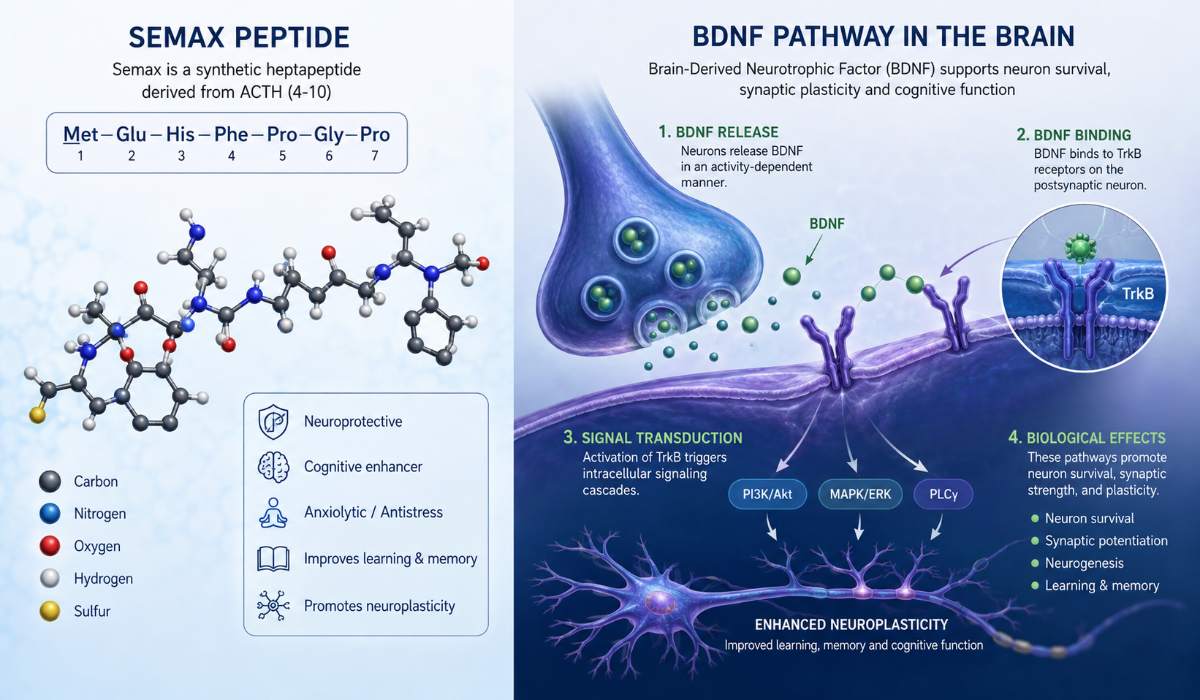
Semax is a synthetic heptapeptide (seven amino acids) derived from the adrenocorticotropic hormone (ACTH) sequence Met-Glu-His-Phe-Pro-Gly-Pro. It was originally developed in Russia in the 1980s and later approved there as a prescription nootropic drug. Its primary mechanism involves upregulating Brain-Derived Neurotrophic Factor (BDNF) and Nerve Growth Factor (NGF) two proteins essential for neuronal health, plasticity, and survival. Think of Semax as the “gas pedal” of cognitive function: it accelerates focus, memory encoding, and mental energy.
For a deeper dive into Semax’s research profile, visit the Semax peptide and the comprehensive Semax peptide benefits guide both of which provide science-backed analysis of its mechanisms and potential applications.
What Is Selank?
Selank is a synthetic heptapeptide analog of the endogenous immunomodulatory peptide Tuftsin (Thr-Lys-Pro-Arg), with the sequence Thr-Lys-Pro-Arg-Pro-Gly-Pro. It was also developed in Russia and has received official approval there as an anxiolytic (anti-anxiety) medication. If Semax is the “gas pedal,” Selank is the “traction control” it reduces anxiety and stress reactivity while maintaining, and often enhancing, cognitive clarity.
Selank’s mechanism centers on the GABAergic system modulating the brain’s primary inhibitory neurotransmitter to produce anxiolytic effects without the sedation, dependence risk, or cognitive blunting associated with traditional benzodiazepine medications. This distinction is critical: Selank calms the mind without dimming it.
Key Research Facts: Semax vs Selank at a Glance
✓ Both peptides are 7 amino acids (heptapeptides) in length
✓ Semax increases BDNF by up to 80% in some animal models (per Russian research)
✓ Selank mimics the body’s natural tuftsin peptide, supporting immune and neural regulation
✓ Both are approved medications in Russia and Ukraine for clinical use
✓ Neither is currently FDA-approved; sold strictly for research purposes in the USA
✓ Both are typically administered via nasal spray for optimal CNS bioavailability
✓ Neither compound has shown significant addiction potential in research models
Mechanism of Action: How Do Semax vs Selank Actually Work?
Semax: The Neurotrophic Catalyst
Semax operates through several interconnected neurochemical pathways. Its primary and most well-documented action is the upregulation of BDNF (Brain-Derived Neurotrophic Factor), often called “Miracle-Gro for the brain.” BDNF supports the growth, maintenance, and survival of neurons, enhances synaptic plasticity (the basis of learning and memory), and protects neural tissue from damage. Semax also stimulates the production of Nerve Growth Factor (NGF) and appears to influence dopaminergic and serotonergic transmission positively.
Additionally, Semax has been shown in research to improve cerebral blood circulation, which may partly explain its reported benefits for stroke recovery research and cognitive resilience under hypoxic (low-oxygen) conditions. Russian clinical research has explored its use in ischemic stroke recovery, where enhanced cerebral circulation could be particularly beneficial.
This neurobiological profile places Semax in a class of compounds sometimes referred to as “cognitive enhancers with neuroprotective properties” a category that also includes other well-researched peptides. If you are interested in how peptides support neural and physical recovery, the BPC-157 and TB-500 explores two other recovery-focused peptides with distinct but complementary mechanisms.
Selank: The GABAergic Stabilizer
Selank’s mechanism is equally sophisticated but targets a fundamentally different system. Its primary action is to enhance GABAergic neurotransmission the brain’s primary inhibitory pathway. This is the same general system that benzodiazepine drugs like diazepam target, but Selank acts differently: it modulates and stabilizes the system rather than flooding it, resulting in reduced anxiety without sedation or loss of cognitive sharpness.
Research also indicates that Selank stabilizes enkephalin metabolism (an endogenous opioid peptide) and influences serotonin and dopamine levels contributing to its mood-stabilizing effects. Furthermore, as a tuftsin analog, Selank may support immune system modulation, a property with broader research implications beyond cognition.
Selank also appears to stabilize brain-derived neurotrophic factor (BDNF) levels an interesting overlap with Semax though its primary BDNF-related action is more about preventing stress-induced BDNF reduction than actively increasing it. This is one reason why the two peptides are considered scientifically compatible when used together.
Semax Research Benefits: What the Science Says
The research literature on Semax, much of it published in Russian-language journals and translated into English, points to a consistent cluster of cognitive and neuroprotective benefits. Below are the major areas where Semax has shown promise in research settings.
1. Enhanced Memory and Learning
Studies in animal models consistently show that Semax enhances memory consolidation and recall. The BDNF upregulation is central here BDNF is one of the most critical molecules for long-term potentiation (LTP), the cellular mechanism underlying memory formation. Researchers have observed improved performance in spatial memory tasks and accelerated learning curves in subjects treated with Semax.
2. Neuroprotection and Stroke Recovery Research
Perhaps the most clinically significant research on Semax concerns its potential for neuroprotection after ischemic events. In Russia, Semax is an approved drug specifically for ischemic stroke and transient ischemic attack (TIA) treatment a testament to the depth of research behind it. Studies suggest it reduces the size of ischemic lesions and supports neural recovery through its BDNF and cerebral circulation-enhancing effects.
3. Cognitive Enhancement and Mental Stamina
Anecdotal research reports and controlled studies both describe enhanced mental stamina, focus, and processing speed with Semax. Subjects report reduced cognitive fatigue during demanding intellectual tasks a property consistent with its BDNF-mediated enhancement of neuronal efficiency. For researchers exploring peptide-based approaches to cognitive performance, the complete Semax peptide benefits science-backed guide offers an extensively referenced overview.
4. ADHD and Attention Research
Some research contexts have examined Semax in relation to attentional disorders. Its dopaminergic and BDNF-mediated effects may be relevant to attention regulation pathways, making it a subject of interest in exploratory neuroscience research on focus and impulse control.
Selank Research Benefits: What the Science Says
1. Anxiety Reduction Without Sedation
The most robustly documented benefit of Selank is its anxiolytic effect comparable in some research to benzodiazepines but without the sedation, motor impairment, or dependency risk. This is a critical distinction for researchers. A 2008 study published in the Bulletin of Experimental Biology and Medicine reported significant anxiolytic effects with preserved cognitive performance, a profile not typically seen with conventional anti-anxiety compounds.
2. Stress Adaptation and Resilience
Selank has shown promise as an adaptogen-like compound in research settings helping subjects maintain physiological and psychological equilibrium under stress. Its tuftsin-mimicking properties may enhance stress resilience at both the neural and immunological levels. Researchers studying high-stress conditions, including military and occupational health contexts, have shown interest in this profile.
3. Sleep Quality and Anxious Insomnia
Through GABAergic modulation and the reduction of stress-related neurochemical dysregulation, Selank has been associated in research with improved sleep architecture particularly in subjects experiencing anxiety-driven insomnia. Unlike pharmaceutical sleep aids, it does not appear to produce significant next-day sedation or impaired cognitive performance.
4. Immune Modulation
As a tuftsin analog, Selank inherits some of Tuftsin’s well-documented immunomodulatory properties. Research has explored its effects on cytokine regulation and T-cell activity. While this research area is early-stage, it suggests that Selank’s biological footprint extends beyond the central nervous system an intriguing property for multidisciplinary researchers. For context on how peptides can have systemic effects, the TB-500 (Thymosin Beta-4) research provides a comparative look at another peptide with immune-relevant properties.
Semax vs Selank: Head-to-Head Research Comparison
Understanding the differences between Semax vs Selank requires examining not just what each does, but when and for what purpose each would be most relevant in a research context. Below, we compare them across five critical dimensions.
1. Cognitive Enhancement: Focus vs. Calm Clarity
Semax is the stronger pure cognitive enhancer of the two. Its BDNF-mediated effects on synaptic plasticity, memory encoding, and mental stamina make it the preferred research compound when the primary goal is maximizing intellectual output, processing speed, and learning efficiency. Selank, while also supporting cognitive function, achieves clarity through a different route by removing the cognitive interference of anxiety and stress. When anxiety is the primary barrier to mental performance, Selank’s approach may be more directly relevant.
2. Anxiety and Stress: Selank Wins Decisively
For anxiety-related research applications, Selank is the clear focus. Semax has some stress-modulating properties through BDNF, but its primary neurochemical actions are stimulatory rather than inhibitory. In subjects where stress or anxiety is the primary variable being studied, Selank’s GABAergic modulation is far more targeted and reliably documented.
3. Neuroprotection: Both Show Promise, Semax More Documented
Both peptides show neuroprotective potential in research. Semax has a stronger research base in stroke and ischemia, with Russian clinical approval for these applications. Selank’s neuroprotective effects are more indirect primarily through stress reduction, which, in turn, reduces neuroinflammatory damage. Researchers focused on neuroprotection may find more published data with Semax, particularly in the stroke recovery literature.
4. Side Effect Profiles: Both Are Research-Friendly
Neither Semax nor Selank is associated with significant adverse effects in published research literature. Both have low toxicity profiles, no reported significant organ toxicity, and low dependency potential particularly relevant when compared to pharmaceutical anxiolytics or stimulants. The most commonly reported effects in human research subjects include mild nasal irritation from spray administration and transient changes in alertness. Researchers interested in comparing the side-effect profiles of peptide compounds can also consult the “How Long Do Semaglutide Side Effects Last?” page for broader context on peptide-related side-effect timelines.
5. Research Documentation: Russia vs. Western Literature
The majority of primary research on both peptides exists in Russian and Eastern European scientific literature. Western researchers should be aware that while the quantity of studies is substantial, translation and methodological differences exist. Both peptides are increasingly being studied in Western academic and independent research contexts, but neither has completed the FDA drug approval process for human use. As such, both remain for research purposes only in Western markets.
Research Dosage Reference: Semax vs Selank
The following dosage information is derived from the existing research literature and is provided solely for educational and research reference. These figures are not medical recommendations and should not be used for self-administration.
| Peptide | Typical Dosage | Frequency | Primary Benefit |
|---|---|---|---|
| Selank | 250–500 mcg per nostril | 1–2x daily | Anxiolytic, anti-stress |
| Semax | 200–600 mcg per nostril | 1–2x daily | Cognitive boost, neuroprotection |
| Selank + Semax (Stack) | 250 mcg each per nostril | Once daily (morning) | Balanced flow state |
Semax vs Selank Together: The Research Case for Stacking
One of the most compelling aspects of Semax vs Selank research is their natural complementarity. The concept of stacking both peptides often called the “Flow State Stack” in research communities is based on their mechanistic compatibility and contrasting but complementary primary actions.
Semax activates cognitive performance (the gas pedal), while Selank prevents the anxiety and stress that often accompany high-performance cognitive states (the traction control). Together, research subjects and preliminary human research data suggest a profile of calm, focused, high-performance cognition without the anxious edge that stimulants often produce or the cognitive dulling associated with conventional anxiolytics.
Research-Reported Benefits of Semax + Selank Stack
✓ Improved learning speed and information retention
✓ Enhanced mental processing without anxiety-induced cognitive interference
✓ Reduced mental fatigue during extended cognitive tasks
✓ Mood stabilization during high-pressure research protocols
✓ Potential neuroprotective synergy through complementary BDNF-related mechanisms
✓ No significant pharmacokinetic interactions identified in existing research
The stack concept is well-established among peptide researchers, and the best peptide research guide covers additional stacking strategies across a broader peptide library.
Choose Semax Research When:
•The primary variable is cognitive enhancement — focus, memory, mental stamina, processing speed
•Neuroprotection is the research focus — particularly ischemic injury, stroke recovery, or BDNF-related neurotrophic research
•ADHD or attentional research — exploring dopaminergic pathways in attention regulation
•Neuroplasticity studies — examining synaptic strengthening and learning efficiency
Choose Selank Research When:
•The primary variable is anxiety or stress — GABAergic modulation, stress adaptation research
•Sleep research — particularly anxiety-induced insomnia models
•Immune-neural interaction research — tuftsin-related immunomodulatory pathways
•Dependency-free anxiolytic research — studying alternatives to benzodiazepine mechanisms
Consider Both (Stack Research) When:
•Studying cognitive performance under stress — where both enhancement and stress management are variables
•Researching “flow state” neurobiology — the intersection of peak performance and psychological calm
•Longitudinal cognitive resilience studies — where both neuroplasticity and stress buffering are relevant outcomes
For researchers building a broader peptide research library, the best peptides for fat loss guide and the best peptide for muscle growth research guide offer insight into how other peptide categories are being studied for distinct physiological targets.
Expanding Your Peptide Research: The Broader Ecosystem
Semax vs Selank are part of a larger, rapidly growing field of peptide science. Researchers who begin with these two neuropeptides often expand their inquiry into adjacent research areas. Below are several well-documented peptide research topics worth exploring.
Recovery-Focused Peptides
While Semax vs Selank primarily act on the central nervous system, other peptides like BPC-157 focus on tissue repair, gut healing, and musculoskeletal recovery. The BPC-157 research guide explores this in depth. Researchers have also explored combination approaches the BPC-157 and TB-500 blend is one such combination product studied for synergistic recovery effects.
Growth Hormone-Related Peptides
The CJC-1295 and Ipamorelin combination is among the most extensively studied growth hormone secretagogue combinations in peptide research. The CJC-1295 Ipamorelin research guide and the CJC-1295 Ipamorelin blend product provide detailed research context for this pairing.
Metabolic Research Peptides
The field of metabolic peptide research has expanded significantly, with compounds such as Tesamorelin being studied for visceral fat reduction. The Tesamorelin 10mg visceral fat research guide offers a comprehensive overview of this area. Researchers interested in IGF-1-related outcomes can also explore the IGF-1 LR3 before and after research summary.
Conclusion:
The Semax vs Selank comparison is ultimately a story of two profoundly elegant peptides, each optimized by decades of neuroscience research for a specific but complementary purpose. Semax accelerates the brain boosting BDNF, enhancing memory, sharpening focus, and protecting neurons from damage. Selank stabilizes the brain reducing anxiety, buffering stress, stabilizing mood, and creating the neurochemical conditions for focused cognitive work without interference.
For researchers, the key insight is not which peptide is “better” but rather which research question each is best suited to answer and whether a combined protocol addresses the full complexity of the cognitive and stress-related phenomena being studied. As the field of peptide research continues to mature in 2026 and beyond, Semax vs Selank remain among its most scientifically compelling subjects.
Researchers can source research-grade Semax 10mg and Selank 10mg through Ageless Vitality Peptides, a dedicated chemical supplier committed to research-grade quality, purity documentation, and regulatory compliance.
⚠ RESEARCH DISCLAIMER: All content in this article is for informational and educational purposes only. The products discussed are chemical reagents intended for laboratory research use only and are not intended for human use, diagnosis, treatment, cure, or prevention of any disease or medical condition. The statements on this page have not been evaluated by the US Food and Drug Administration. Ageless Vitality Peptides is a chemical supplier, not a pharmacy or medical provider. Always consult a qualified healthcare professional and comply with all applicable laws and regulations in your jurisdiction.
Frequently Asked Questions (FAQs)
What is the primary difference between Semax vs Selank?
Semax is a nootropic peptide primarily studied for cognitive enhancement memory, focus, and neuroprotection through BDNF upregulation. Selank is an anxiolytic peptide primarily studied for anxiety reduction and stress resilience through GABAergic modulation. They represent complementary rather than competing research tools.
Which peptide is better for anxiety research Semax vs Selank?
Selank is the more directly relevant peptide for anxiety-focused research. Its GABAergic mechanism, anxiolytic research documentation, and official Russian approval as an anxiolytic drug make it the clear choice for research exploring anxiety, stress, and related neurochemical pathways.
Which peptide is better for cognitive enhancement research?
Semax is the stronger cognitive enhancer in research terms, particularly for studies focused on memory encoding, learning efficiency, BDNF-related neuroplasticity, or neuroprotection following ischemic events. It’s documented that BDNF upregulation distinguishes it as a primary nootropic research compound.
Are Semax vs Selank FDA-approved?
No, Neither Semax nor Selank is FDA-approved for human use in the United States. Both are approved medications in Russia and Ukraine for specific clinical indications, but remain research-only compounds in Western markets. They are sold strictly for research purposes by compliant chemical suppliers.
Can Semax vs Selank be stacked together?
Yes, research supports the compatibility of Semax vs Selank. Their different mechanisms (BDNF vs. GABA) do not conflict, and combined use is reported to produce a balanced “flow state” profile in research subjects: enhanced cognitive performance with reduced anxiety interference.
What is the typical research administration route for Semax and Selank?
Both are most commonly administered via nasal spray in research settings, which provides direct CNS access via the olfactory pathway. Subcutaneous injection is also used in some research protocols. Intravenous administration exists in some older Russian clinical literature.
Where can I source research-grade Semax vs Selank?
Research-grade Semax 10mg and Selank 10mg are available through Ageless Vitality Peptides a compliant chemical supplier offering research-grade peptides with documented purity for legitimate research purposes.