Sterile Water for Peptide Reconstitution | Research Guide
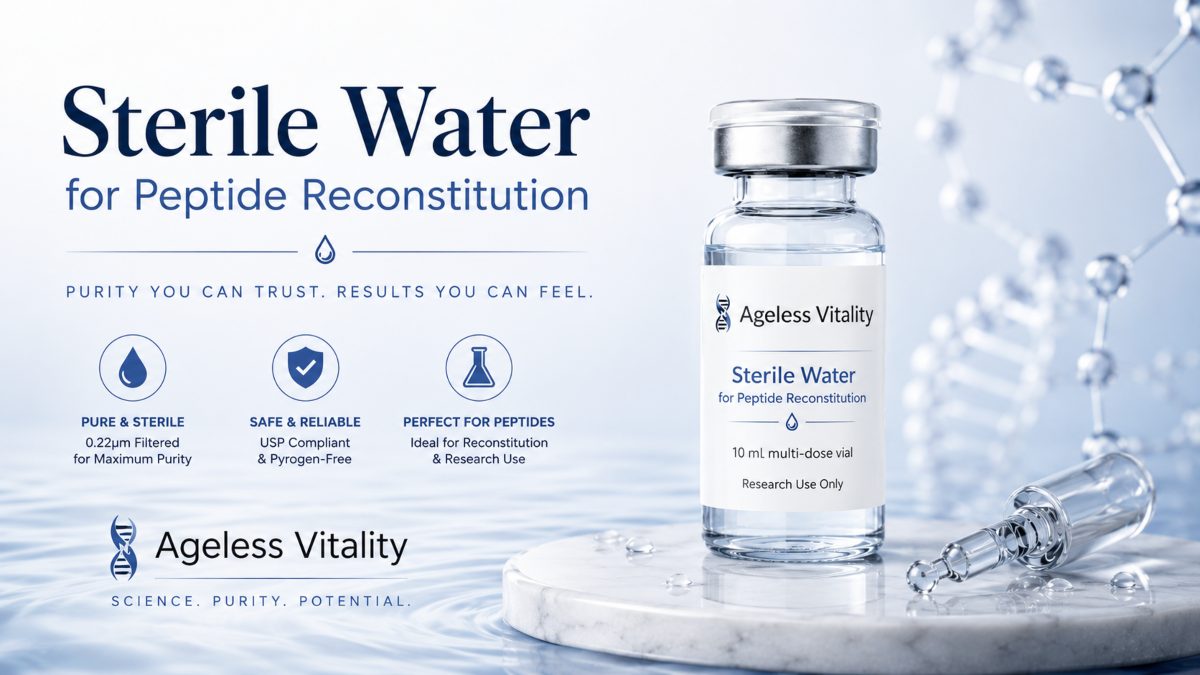
Sterile water for peptide reconstitution is the foundational vehicle used in laboratory research to dissolve lyophilized peptides into a stable, usable solution. For researchers working with sensitive peptide compounds, the choice of reconstitution vehicle is not a minor detail it directly affects compound integrity, solubility, and the reliability of experimental results.
Peptides are typically supplied in lyophilized (freeze-dried) powder form to maximize shelf life and stability during shipping and storage. Before use in a research setting, they must be reconstituted into liquid form. The vehicle used in this process its sterility, pH, ionic composition, and absence of preservatives can influence how a peptide behaves once dissolved. Sterile water, free of ions, preservatives, and biological contaminants, provides a chemically neutral baseline that researchers depend on when precision matters.
This guide covers what sterile water for reconstitution actually is at the formulation level, how it compares to alternatives like bacteriostatic water and normal saline, and what sterile technique looks like in a properly controlled research environment. For a broader overview of peptide classes and their research applications, the Peptide Sciences Complete Research Guideis a useful companion resource.
All compounds and reconstitution methods referenced in this guide are discussed in the context of laboratory and preclinical research only. Products sold by Ageless Vitality Peptides are research-grade chemical reagents intended for scientific study, not for human use, diagnosis, treatment, or prevention of any disease or condition.
What Is Sterile Water for Peptide Reconstitution?
Sterile water for peptide reconstitution is highly purified water processed to eliminate microbial contamination, particulate matter, and dissolved impurities, making it suitable as a solvent for dissolving lyophilized peptides in research applications. Unlike general-purpose laboratory water, reconstitution-grade sterile water is produced and packaged under controlled conditions to preserve the chemical neutrality required by sensitive peptide structures.
How Sterile Reconstitution Solution Is Defined in Research Contexts
In research settings, a sterile reconstitution solution is defined by what it lacks as much as what it contains. It is free of viable microorganisms, pyrogens, preservatives, and ionic solutes that could interfere with a peptide’s solubility, folding behavior, or stability once dissolved. The United States Pharmacopeia (USP) sets the benchmark for sterile water specifications widely referenced in laboratory and research-grade manufacturing including limits on bacterial endotoxins, conductivity, and total organic carbon. Research-grade sterile water produced to these standards gives researchers a reproducible, chemically inert starting point for solution preparation.
How It Differs from Tap Water, Distilled Water, and Injectable-Grade Water
Not all purified water is equivalent, and the differences matter in peptide research. Tap water contains chlorine, fluoride, dissolved minerals, and microbial load none of which belong near a research-grade peptide compound. Distilled water removes many dissolved solids through evaporation and condensation but does not guarantee sterility; a distilled water source can still harbor endotoxins or reintroduce contaminants during storage. Injectable-grade water Water for Injection (WFI) meets the most stringent pharmaceutical manufacturing standards and is produced by distillation or reverse osmosis under tightly controlled conditions.
Research-grade sterile reconstitution water occupies a functionally similar position for laboratory use: processed to remove biological and chemical contaminants, packaged in sealed sterile vials, and intended for single or controlled-use application rather than broad industrial purposes.
What “Sterile” Means at the Formulation Level
Sterility at the formulation level means the complete absence of viable microorganisms, as validated by recognized testing method not merely a reduction in contamination. Achieving this requires either terminal sterilization (typically moist heat/autoclaving) or aseptic processing, where the water is filtered through 0.22-micron membranes and filled into containers under ISO-classified cleanroom conditions. The 0.22-micron filtration threshold is the industry-recognized standard for sterilizing filtration, as it reliably excludes bacteria, yeast, and molds. For researchers, the practical implication is straightforward: sterile water packaged in a sealed, single-use vial provides a contamination-controlled vehicle that tap water, distilled water, and unvalidated lab-grade water cannot reliably replicate.
Sterile Water vs Bacteriostatic Water Which Do Researchers Use?
Sterile water and bacteriostatic water are both used in peptide reconstitution research. Still, they serve distinct purposes, depending on how the reconstituted solution will be used and how long it needs to remain stable. Choosing the wrong vehicle for a given research protocol is one of the most common sources of avoidable variability in peptide studies. For a full walkthrough of the reconstitution process itself, see the guide on how to reconstitute peptides.
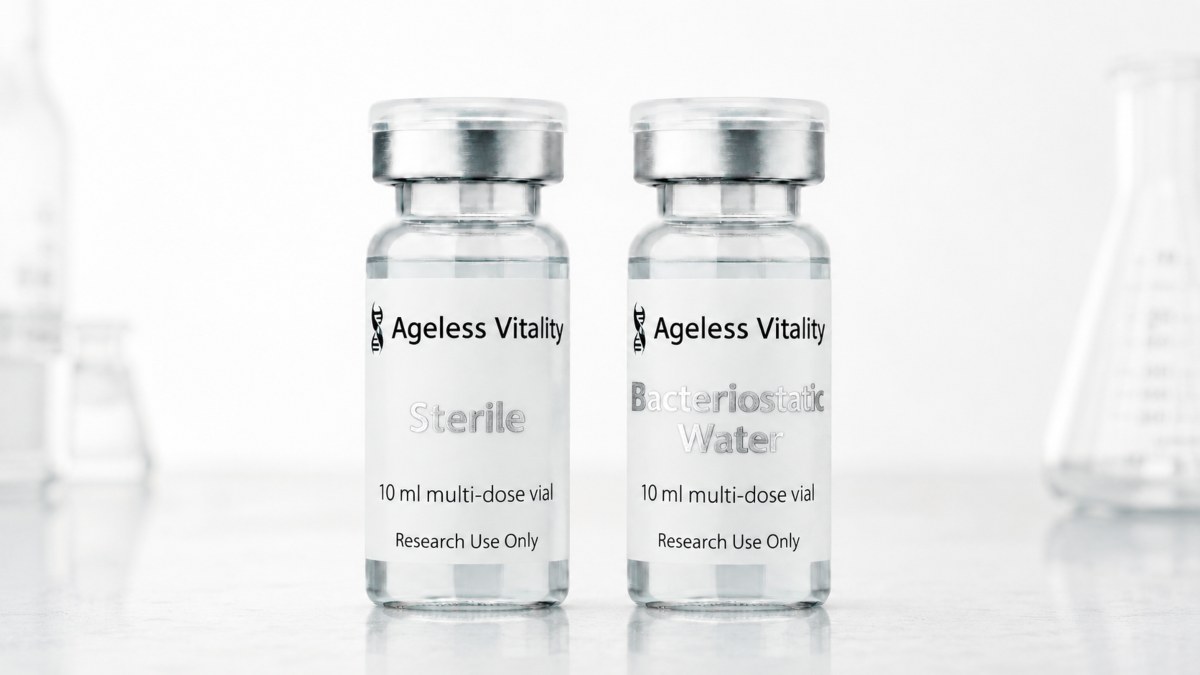
Key Differences in Composition and Preservation
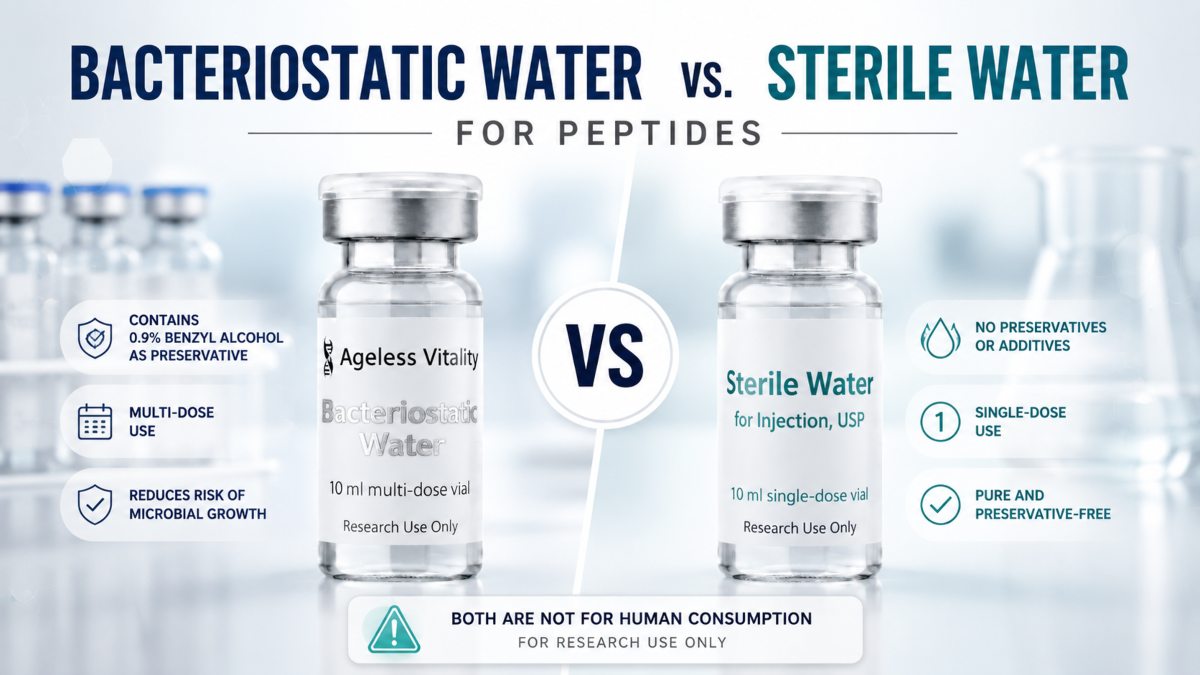
The fundamental difference between the two comes down to one ingredient: benzyl alcohol. Bacteriostatic water contains 0.9% benzyl alcohol, a preservative that inhibits the growth of bacteria and other microorganisms after the vial seal is broken. Sterile water contains no preservatives whatsoever it is pure, sterilized water in a sealed container. Once that seal is broken, sterile water offers no ongoing protection against microbial contamination. This distinction makes the two vehicles appropriate for entirely different research scenarios, and the decision between them should be made before reconstitution begins, not after.
When Sterile Water Is the Correct Choice for Single-Use Reconstitution
Sterile water is the appropriate reconstitution vehicle when the entire prepared solution will be used within a single research session or when the peptide compound being studied is sensitive to benzyl alcohol. Some peptide structures particularly shorter-chain or more reactive sequences can interact unfavorably with preservatives, introducing a confounding variable into experimental results. For single-use reconstitution, the absence of benzyl alcohol removes that variable entirely. Researchers preparing solutions for immediate use in controlled in vitro or analytical applications will typically default to sterile water for this reason.
Why Bacteriostatic Water Is Used for Multi-Dose Research Storage
When a reconstituted peptide solution needs to be stored and accessed multiple times over an extended research period, bacteriostatic water provides the microbial control that sterile water cannot. The 0.9% benzyl alcohol concentration is sufficient to inhibit bacterial proliferation across repeated needle entries into the vial a critical consideration when a sealed container is punctured more than once. Research protocols that require consistent access to the same solution over days or weeks rely on this preservative effect to maintain solution integrity between uses. Without it, even careful aseptic technique cannot fully prevent microbial introduction across multiple punctures.
Stability Implications in Peptide Research Protocols
Peptide stability in aqueous solution is influenced by temperature, pH, light exposure, and the chemical environment of the solvent and the choice between sterile and bacteriostatic water affects that environment. Benzyl alcohol, while effective as a preservative, can affect solution pH and interact with specific amino acid residues in certain peptide sequences. For research protocols in which long-term structural integrity or precise biochemical characterization is the objective, these interactions should be accounted for at the protocol design stage. A 2020 review in the Journal of Pharmaceutical Sciencesnoted that preservative-induced degradation pathways remain an underreported source of variability in peptide stability studies reinforcing the need for deliberate attention to vehicle selection rather than default habit.
Sterile Water vs. Normal Saline for Reconstitution
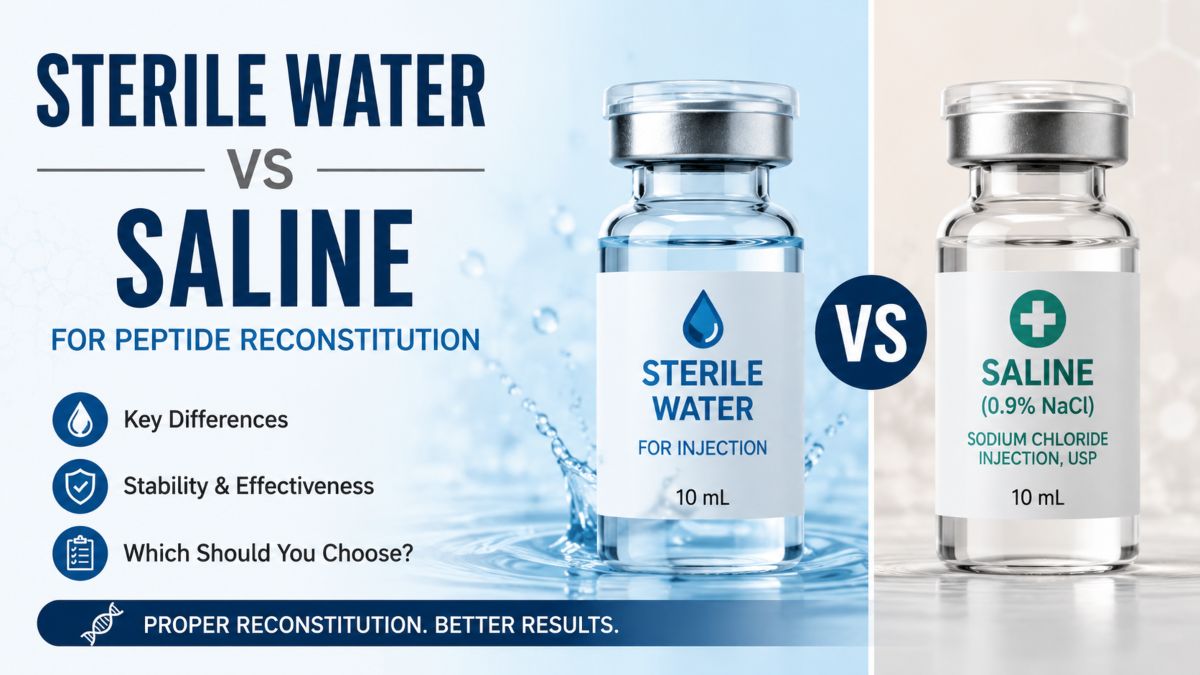
Sterile water and normal saline are not interchangeable reconstitution vehicles in peptide research the presence of sodium chloride in saline introduces ionic and osmotic variables that can meaningfully affect a peptide’s behavior in solution. Understanding when each vehicle is appropriate requires examining what sodium chloride does at the molecular level once a peptide is dissolved.
Why Sodium Chloride Content Matters in Peptide Research
Normal saline 0.9% sodium chloride in sterile water is isotonic with human physiological fluids, making it a standard vehicle for clinical and pharmaceutical applications. In peptide research, however, that same ionic content becomes a variable that needs to be controlled for, not assumed to be neutral. Sodium and chloride ions interact with charged amino acid residues on peptide chains, and depending on the sequence, this ionic environment can influence solubility, aggregation behavior, and secondary structure. For researchers conducting structural characterization, binding assays, or solubility profiling, introducing sodium chloride unintentionally adds a confounding factor that complicates result interpretation. Sterile water, being ion-free, eliminates that variable and gives researchers a chemically defined baseline.
Osmolarity Considerations in Research-Grade Reconstitution
Osmolarity the concentration of solute particles in a solution is a parameter that matters significantly in certain categories of peptide research, particularly studies examining cellular uptake, membrane interactions, or any protocol where the reconstituted solution comes into contact with biological material. Normal saline at 0.9% has an osmolarity of approximately 308 mOsm/L, closely matching physiological levels. Sterile water, by contrast, is hypotonic it has essentially zero osmolarity on its own.
Neither value is inherently superior; the appropriate choice depends entirely on the experimental design. When a research protocol requires a physiologically relevant osmotic environment, saline may be the deliberate choice. When the protocol requires a defined, ion-free solvent or when the peptide will be further diluted into a buffered system, sterile water is typically the correct starting point.
When Saline Is Appropriate and When It Is Not
Normal saline is a reasonable reconstitution vehicle in peptide research when the experimental context specifically calls for an isotonic, physiologically relevant solution for example, in certain cell-based assays or ex vivo tissue studies where osmotic stress would itself be a confounding variable. It is generally not appropriate when the research objective involves precise solubility measurements, structural analysis, or assays sensitive to ionic strength.
It is also a poor default choice for peptides with known aggregation tendencies at higher ionic concentrations, as salt can accelerate aggregation in some sequences. The broader principle is that saline should be a deliberate, protocol-justified selection not the default simply because it is familiar or widely available. When in doubt, sterile water provides a more controlled, chemically neutral starting environment for initial reconstitution work.
Is Reconstitution Solution the Same as Sterile Water?
Reconstitution solution and sterile water are closely related. Still, not always identical the term “reconstitution solution” describes the intended application. In contrast “sterile water” describes the base composition, and commercial research products may use these terms interchangeably or distinctly depending on their formulation and labeling conventions. For researchers sourcing reconstitution vehicles, understanding what is actually in the vial matters more than what the label calls it.
Understanding the Terminology: Sterile Water, Sterile Reconstitution Solution, WFI
Three terms appear frequently in research and pharmaceutical contexts, and they are not synonymous. Sterile water is the broadest category purified water that has been sterilized by heat or filtration and packaged under controlled conditions. Water for Injection (WFI) is a more specific pharmacopeial designation defined by USP and EP monographs, produced by distillation or validated membrane processes, and held to strict limits on endotoxins, conductivity, and total organic carbon.
Sterile reconstitution solution is a functional descriptor rather than a strict formulation category it refers to any sterile aqueous vehicle intended specifically for dissolving lyophilized compounds before research use. In practice, many commercial research reconstitution solutions are formulated to WFI-equivalent standards, but that equivalence is only meaningful when the supplier provides documentation to confirm it.
How Commercial Research Reconstitution Solutions Are Formulated
Most research-grade sterile reconstitution solutions sold for peptide applications are formulated as either plain sterile water or sterile water with a low-concentration preservative such as benzyl alcohol the latter being bacteriostatic water under a different commercial name. Some specialty reconstitution solutions include pH-adjusting agents, such as dilute acetic acid, which improve the solubility of peptides with poor aqueous solubility at neutral pH. The manufacturer’s formulation choice has direct implications for how the solution interacts with the dissolved peptide, which is why certificate of analysis (CoA) documentation is the appropriate basis for sourcing decisions not product naming alone. Research suppliers who provide CoA data, endotoxin testing results, and clearly stated formulation compositions give researchers the information needed to make protocol-appropriate choices.
Why Labeling and Sourcing Matter for Research-Grade Compounds
In research-grade chemical supply, labeling accuracy and sourcing transparency are functional quality indicators. A vial labeled “sterile reconstitution solution” without accompanying documentation leaves the researcher without confirmation of sterility method, endotoxin levels, preservative content, or pH all variables that can affect experimental outcomes. The FDA’s guidance on research-grade chemical suppliers emphasizes that quality characterization data should accompany research compounds and their associated reagents, a standard that applies directly to reconstitution vehicles. Sourcing sterile water or reconstitution solution from a supplier that provides batch-specific CoA documentation is not bureaucratic caution it is basic protocol hygiene that protects the integrity of the research. For peptide researchers, the vial the compound dissolves into deserves the same sourcing scrutiny as the compound itself.
Sterile Technique in Peptide Reconstitution
Sterile technique in peptide reconstitution refers to the set of procedural practices researchers use to prevent microbial and particulate contamination from entering a solution during preparation. Even when working with research-grade sterile water and high-purity peptide compounds, a lapse in technique during reconstitution can compromise the integrity of the entire preparation. Researchers new to this process will find the step-by-step breakdown in the how to reconstitute peptidesguide a useful procedural reference.
Core Principles of Aseptic Technique in Research Settings
Aseptic technique is built on a single governing principle: nothing non-sterile contacts a sterile surface, solution, or container opening. In practice, this means working with sterile-packaged consumables, minimizing the time any sterile surface is exposed to the open environment, and maintaining spatial discipline to keep non-sterile materials including hands, clothing, and unsterilized equipment away from the sterile field. The CDC estimates that a significant proportion of laboratory contamination events are attributable to procedural failures rather than equipment malfunction, which underscores that technique is the primary control, not the secondary one. For peptide reconstitution specifically, aseptic discipline is applied from the moment a vial seal is broken through to final solution storage.
Working in Sterile Environments Laminar Flow Hoods and Biosafety Cabinets
The environment in which reconstitution occurs is as important as the materials used. Laminar flow hoods direct HEPA-filtered air across the work surface in a uniform, unidirectional stream, displacing ambient air and dramatically reducing the particulate load at the work surface. Biosafety cabinets serve a related but distinct function they protect both the researcher and the sample by recirculating air through HEPA filtration while maintaining an inward airflow barrier. For peptide reconstitution in a research context, a horizontal or vertical laminar flow hood is the standard working environment when contamination-free solution preparation is the objective. Researchers working without access to controlled airflow environments must compensate with heightened procedural discipline and accept a higher baseline contamination risk.
Contamination Risks and How Research Protocols Address Them
The primary contamination vectors in peptide reconstitution are airborne particulates, contact transfer from non-sterile surfaces, and microbial introduction through repeated vial puncture. Research protocols address these risks through a layered approach: using sealed, single-use sterile water vials where possible, swabbing rubber septumswith 70% isopropyl alcohol before each needle entry, using sterile-packaged syringes and needles opened immediately before use, and minimizing the number of times any vial is punctured. Each additional puncture of a vial septum increases the cumulative contamination risk, which is why single-use sterile water vials are the preferred vehicle for reconstitution protocols in which the entire volume will be used in a single session.
Proper Vial Handling and Syringe Technique for Research Use
Correct vial and syringe handling is the final execution layer of sterile technique. When withdrawing sterile water for reconstitution, the syringe needle should penetrate the center of the alcohol-wiped septum at a shallow angle to minimize coring the physical displacement of rubber particles into the solution. Solution should be introduced into the peptide vial slowly, directed against the glass wall rather than directly onto the lyophilized powder, to prevent foaming and mechanical degradation of the peptide structure. The vial should then be gently swirled never shaken until the powder is fully dissolved. Vigorous agitation introduces air bubbles and can disrupt peptide secondary structure, particularly in longer or more structurally complex sequences. Each of these steps is a small procedural choice; collectively, they determine whether the reconstituted solution is fit for research use.
Reconstituting Research Peptides with Sterile Water What the Literature Shows
The peer-reviewed literature consistently positions sterile water as a reliable and chemically appropriate reconstitution vehicle for the majority of research peptide classes, while also identifying the conditions under which its limitations become relevant. What the research makes clear is that sterile water is not a universal default it is the correct choice within a defined set of experimental parameters, and understanding those parameters is what separates reproducible research from variable outcomes.
How Sterile Water Performs as a Reconstitution Vehicle Across Compound Classes
Across the broad landscape of synthetic and recombinant peptides studied in preclinical research, sterile water performs reliably as a reconstitution vehicle for compounds with moderate to high aqueous solubility and neutral to mildly charged amino acid profiles. Short-chain peptides, peptide fragments, and many signaling peptides dissolve readily in sterile water at room temperature, without pH adjustment or the need for cosolvents. Longer sequences, highly hydrophobic peptides, or compounds with strong net charges at neutral pH present more solubility challenges not because sterile water is inadequate as a vehicle, but because the physicochemical properties of those compounds demand a more tailored solvent environment.
Researchers working across compound categories from growth hormone secretagogues like Sermorelinand the CJC-1295 + Ipamorelin Blendto tissue-repair compounds like BPC-157and TB-500, to metabolic peptides studied in fat-loss research contexts will encounter different solubility profiles that determine whether plain sterile water is sufficient or whether pH adjustment is warranted. For researchers focused on fat-loss compound classes, the best peptide for fat lossoverview covers which compound categories are most commonly studied in that context. Similarly, researchers exploring muscle-growth applications will find relevant compound context in the best peptide for muscle growthguide.
A 2019 analysis published in the European Journal of Pharmaceutics and Biopharmaceuticsfound that solubility failures in peptide reconstitution were more frequently attributable to compound-specific physicochemical properties than to vehicle selection, reinforcing that sterile water remains the appropriate starting point for initial solubility assessment across most compound classes.
pH and Solubility Considerations Relevant to Research
Sterile water has a theoretical pH of 7.0 but in practice equilibrates to a slightly acidic pH of around 5.0 to 6.5 upon exposure to atmospheric carbon dioxide, which dissolves into the water and forms dilute carbonic acid. For most peptide reconstitution work, this slight acidity is inconsequential. For compounds that are particularly pH-sensitive including certain cyclic peptides, disulfide-bridged sequences, and peptides with acid-labile modifications the reconstitution pH is a variable worth monitoring and controlling. Researchers working with solubility-challenged peptides frequently use dilute acetic acid (typically 0.1% to 1%) or dilute hydrochloric acid as a co-solvent alongside sterile water to shift the pH environment and improve dissolution. This approach is well documented in the peptide handling literature and does not depart from research-grade standards it is an informed adjustment to the base sterile water vehicle based on the compound’s known chemistry.
Peptide Stability in Aqueous Reconstitution General Research Findings
Once dissolved in sterile water, peptide stability is governed by a predictable set of degradation pathways: hydrolysis of peptide bonds, oxidation of susceptible residues such as methionine and cysteine, and aggregation driven by hydrophobic interactions or electrostatic clustering. The rate at which these processes occur depends on peptide sequence, concentration, temperature, and storage conditions after reconstitution.
The general research consensus is that reconstituted peptide solutions stored in sterile water should be kept at 2–8°C for short-term use and at −20°C or below for longer-term storage, with freeze-thaw cycles minimized to reduce the risk of aggregation. A frequently cited benchmark in peptide stability literature is that aqueous peptide solutions stored above 4°C show measurable degradation within 24 to 72 hours for many sequences. This finding underscores why reconstitution volume should be matched to immediate research needs rather than prepared in excess and stored at ambient temperature.
Stability considerations are particularly relevant for longer-chain or more structurally sensitive compounds. Skin-focused peptides such as GHK-Custudied extensively for collagen synthesis and dermal repair research and nootropic peptides like Semaxand Selankeach present distinct stability profiles in aqueous solution. Researchers comparing these two neuropeptides may find the Semax vs Selankresearch overview useful for understanding their respective handling characteristics. For skin peptide research more broadly, the peptides for skinresource covers the compound classes most commonly examined in dermatological research contexts.
VitalPrep Sterile Reconstitution Solution Designed for Research Applications
Not all sterile water sold for research use is produced to the same standard. For researchers who have invested in high-purity peptide compounds, the reconstitution vehicle deserves equal sourcing scrutiny. VitalPrep Sterile Reconstitution Solutionis formulated specifically for research applications providing a chemically controlled, contamination-managed vehicle designed to meet the preparation demands of serious laboratory work.
What Sets a Purpose-Formulated Research Reconstitution Solution Apart
General-purpose sterile water and purpose-formulated research reconstitution solutions differ in how they are produced, packaged, and documented. A purpose-formulated solution is manufactured with the specific use case in mind meaning vial size, fill volume, septum design, and packaging are all optimized for the repeated, precise withdrawals that peptide reconstitution requires. Beyond the physical format, purpose-formulated research solutions are accompanied by batch-specific quality documentation that general laboratory water products typically do not provide. For researchers who need to maintain protocol reproducibility across multiple reconstitution sessions, this documentation is not supplementary it is part of the quality chain that connects the reconstitution vehicle to the experimental record.
Quality, Sterility, and Sourcing Standards
VitalPrep Sterile Reconstitution Solutionis produced under controlled manufacturing conditions and supplied with certificate of analysis documentation covering sterility, endotoxin levels, and formulation composition. The solution is packaged in sealed, research-appropriate vials designed to maintain sterile integrity from the point of manufacture through to first use.
Sourcing reconstitution solution from a supplier who provides this level of documentation matters because peptide research outcomes are only as reliable as every input in the preparation chain. A compound of high purity, dissolved in an undocumented, inadequately tested vehicle, introduces a quality gap that no downstream analytical step can fully correct. Ageless Vitality Peptides supplies VitalPrep as a research reagent consistent with its position as a chemical supplier operating under research-use-only standards not as a pharmaceutical compounder, pharmacy, or clinical provider.
How VitalPrep Fits Into a Compliant Research Workflow
VitalPrep Sterile Reconstitution Solution is designed to slot directly into a standard research reconstitution workflow without requiring reformulation, pH adjustment, or additional processing for the majority of commonly studied peptide classes. Researchers sourcing lyophilized peptide compounds from Ageless Vitality Peptides can use VitalPrep as the paired reconstitution vehicle, maintaining sourcing consistency and documentation continuity across both the compound and its preparation reagent. For research programs where protocol standardization and supplier documentation are part of the quality framework, having both inputs from a single research-grade chemical supplier simplifies the sourcing record without compromising on either component.
This pairing is straightforward across the full compound catalog whether working with metabolic research compounds like GLP-2 T, GLP-1 S, or GLP-3 R (Retatrutide), or with recovery-focused compounds such as the BPC-157 + TB-500 Blendand IGF-1 LR3. Researchers studying GLP-3 R specifically may also find the Retatrutide vs Tirzepatidecomparative overview and the how long will 10mg of Retatrutide lastguide useful reference points for research planning.
VitalPrep Sterile Reconstitution Solutionis available directly through the Ageless Vitality Peptides product catalog. As with all products on this platform, it is supplied for research purposes only and is not intended for human use, clinical application, or compounding.
Frequently Asked Questions (FAQs)
Can You Reconstitute Peptides with Sterile Water?
Yes, Sterile water is commonly used for peptide reconstitution because it is ion-free and preservative-free, reducing chemical interference. It provides a neutral solvent base suitable for most peptides. If solubility is low, a mild pH adjustment (e.g., dilute acid) may be used, depending on the compound’s properties.
Is Sterile Water the Same as Sterile Saline?
No, Sterile water contains only purified, contaminant-free water, while sterile saline includes 0.9% sodium chloride. The added ions in saline can influence peptide charge behavior and solubility. They are not interchangeable in controlled research protocols.
What Happens If You Use Non-Sterile Water for Peptide Reconstitution in Research?
Non-sterile water may introduce microbes, endotoxins, and impurities that degrade peptides or distort results. It can also trigger unwanted reactions in cell-based assays. This leads to unreliable and non-reproducible experimental data.
How Long Is a Peptide Stable After Reconstitution with Sterile Water?
Typically, peptides last 24–72 hours at 2–8°C depending on sequence and concentration. At −20°C, stability can extend to weeks or months if properly aliquoted. Freeze-thaw cycles should be avoided to prevent degradation.
Does the Type of Water Affect Peptide Solubility?
Yes, Ionic strength and additives directly impact solubility and aggregation behavior. Sterile water offers a neutral baseline for testing true solubility. Saline or bacteriostatic water may alter dissolution due to ionic or preservative effects.