PT-141 Peptide Bremelanotide: What Researchers Should Know
Among the growing landscape of research peptides, PT-141 (Bremelanotide) stands in a category entirely its own. While most compounds in the peptide research space target metabolic pathways, muscle recovery, or cognitive enhancement, PT-141 Peptide operates on the central nervous system specifically targeting the neurological roots of sexual motivation and arousal.
For researchers and clinicians following the evolving landscape of peptide science, PT-141 represents a distinct class of melanocortin receptor agonists. It is not a vascular dilator. It is not a hormonal compound. It is a neuropeptide one that works upstream of desire itself.
This guide is designed to give researchers, health professionals, and informed individuals a comprehensive, science-backed overview of PT-141 Peptide: its mechanism, pharmacology, preclinical and clinical research context, comparisons with other agents, and where to source research-grade PT-141 for legitimate laboratory use.
⚠️ FDA Disclaimer: The statements made on this website have not been evaluated by the US Food and Drug Administration. The statements and products offered by Ageless Vitality Peptides are not intended to diagnose, treat, cure, or prevent any disease. Our products are chemical reagents intended for research purposes only and are not for human use. We do not sell to patients. Ageless Vitality Peptides is a chemical supplier. Ageless Vitality Peptides is not a compounding pharmacy or chemical compounding facility as defined under 503A of the Federal Food, Drug, and Cosmetic Act. Ageless Vitality Peptides is not an outsourcing facility as defined under 503B of the Federal Food, Drug, and Cosmetic Act. Please review our Terms & Conditions before placing an order.
What Is PT-141 (Bremelanotide)?
PT-141, scientifically known as Bremelanotide, is a synthetic analog of alpha-melanocyte-stimulating hormone (α-MSH). It was originally derived from Melanotan II another melanocortin peptide studied for its tanning and sexual effects but PT-141 Peptide was isolated specifically for its centrally-acting sexual arousal properties, without the pigmentation-altering effects.
Its molecular formula is C₅₀H₆₈N₁₄O₁₀, and it operates as an agonist at melanocortin receptors primarily MC3R and MC4R which are expressed throughout the hypothalamus, the brain region governing sexual behavior, appetite, and energy homeostasis.
In 2019, the FDA approved a formulation of bremelanotide under the brand name Vyleesi, specifically for premenopausal women diagnosed with hypoactive sexual desire disorder (HSDD). This approval marked a significant milestone: it was only the second FDA-approved pharmaceutical treatment for HSDD in women, and the first injectable one.
PT-141 Peptide Quick Facts Table
| Parameter | Detail |
|---|---|
| Chemical Name | Bremelanotide |
| Molecular Formula | C₅₀H₆₈N₁₄O₁₀ |
| Peptide Class | Melanocortin Receptor Agonist |
| Primary Receptors | MC3R, MC4R |
| Route of Administration | Subcutaneous injection |
| Onset of Action | 45–60 minutes |
| Duration of Effects | 6–12+ hours |
| FDA-Approved Brand | Vyleesi (for HSDD in premenopausal women) |
| Research Form | PT-141 10mg vials (lyophilized) |
| Storage | Lyophilized: 2–8°C; reconstituted: use within 30 days |
How Does PT-141 Peptide Work? Mechanism of Action Explained
Targeting the Central Nervous System
The defining characteristic of PT-141 that sets it apart from every other sexual health compound is its central mechanism of action. Whereas phosphodiesterase-5 (PDE-5) inhibitors like sildenafil and tadalafil operate peripherally increasing blood flow to genital tissue PT-141 bypasses vascular physiology entirely and acts directly on the brain.
Specifically, PT-141 activates melanocortin-3 and melanocortin-4 receptors in the paraventricular nucleus of the hypothalamus a brain region well-documented in animal and human studies as the central coordinator of sexual motivation and behavior.
When MC4R is stimulated by PT-141, a downstream cascade initiates:
- Dopaminergic activation — dopamine pathways associated with sexual reward and motivation are upregulated
- Oxytocin release — the bonding and arousal neuropeptide is triggered
- Autonomic response — genital blood flow and sensitivity increase, not through direct vascular action, but as a downstream effect of central signaling
This is why researchers describe PT-141 Peptide as the “ignition” rather than the “fuel” it activates the desire pathway at its neurological root.
PT-141 vs PDE-5 Inhibitors: A Mechanistic Comparison
| Feature | PT-141 (Bremelanotide) | PDE-5 Inhibitors (e.g., Sildenafil) |
|---|---|---|
| Mechanism | Central CNS (brain) | Peripheral (vascular) |
| Target receptors | MC3R, MC4R | PDE-5 enzyme |
| Effect on desire | Yes — neurological arousal | No |
| Requires sexual stimulation | Less dependent | Required |
| Works in women | Yes (FDA-approved) | Limited evidence |
| Duration | 6–24 hours | 4–6 hours |
| Route | Subcutaneous injection | Oral |
PT-141 Research History: From Melanotan to Vyleesi
Origins in Melanocortin Research
PT-141 Peptide story begins at the University of Arizona in the 1980s, where researchers studying skin-tanning compounds synthesized Melanotan I and later Melanotan II. In initial studies, Melanotan II unexpectedly produced spontaneous erections in male subjects an observation that redirected research attention entirely toward sexual physiology.
Palatin Technologies isolated the specific peptide sequence responsible for the sexual arousal effects, creating PT-141 Peptide stripped of the pigmentation mechanism but retaining the potent melanocortin-driven arousal signaling. Decades of preclinical and clinical trials followed before the FDA’s 2019 approval for HSDD.
Key Milestones in PT-141 Research
| Year | Milestone |
|---|---|
| 1984 | University of Arizona begins melanocortin peptide research |
| 1996 | Melanotan II trials reveal unexpected sexual arousal effects |
| 2000s | Palatin Technologies develops PT-141 / Bremelanotide |
| 2008 | Phase II clinical trials show efficacy for HSDD in women |
| 2017 | NDA submitted to FDA for Vyleesi |
| 2019 | FDA approves Vyleesi (bremelanotide) for HSDD |
| 2020–2026 | Ongoing research into male sexual dysfunction and neurological applications |
PT-141 in Clinical Research: What Do Studies Show?
Research in Female Sexual Dysfunction (HSDD)
The pivotal clinical trials that led to FDA approval included over 1,200 premenopausal women diagnosed with generalized acquired HSDD. Studies used the Female Sexual Function Index (FSFI) and the Female Sexual Distress Scale (FSDS-DAO) as validated outcome measures.
Key findings across Phase II and III trials:
- Women receiving PT-141 showed statistically significant increases in satisfying sexual events per month compared to placebo
- Reduction in sexual distress scores was observed across multiple validated instruments
- Effects were noted within the first treatment cycle and maintained across the 12-week study period
- Response was not limited to any one demographic subgroup efficacy was consistent across age ranges within the premenopausal population
Research Context for Male Sexual Dysfunction
While PT-141’s FDA approval is specifically for HSDD in women, substantial preclinical and Phase II research has examined its effects in men particularly in cases where psychological or neurological factors contribute to sexual dysfunction that vascular agents alone cannot address.
Early trials in men showed that PT-141 produced penile erections in the absence of external stimulation a finding with significant mechanistic implications, as it demonstrated central-pathway arousal independent of peripheral vascular action. This made it particularly interesting to researchers studying cases where PDE-5 inhibitors provide insufficient benefit.
For researchers exploring peptide combinations in the neurological and endocrine spaces, PT-141’s profile complements compounds like Semax 10mg and Selank 10mg, which also act on neuropeptide and receptor systems with distinct but overlapping domains.
PT-141 Dosage Protocols in Research Contexts
⚠️ This section is intended for informational and research context only. Ageless Vitality Peptides products are for laboratory research use only and not for human administration.
Standard Research Dosage Parameters
Based on clinical trial literature and published pharmacological data, the following dosage parameters have been documented in research settings:
| Parameter | Range / Documented in Research |
|---|---|
| Dose (women – HSDD) | 1.75 mg subcutaneous |
| Dose (men – off-label research) | 1–2 mg subcutaneous |
| Injection site | Abdomen or thigh |
| Administration timing | 45–60 minutes prior to activity |
| Maximum frequency | Once per 24-hour period |
| Duration of effect | 6–12 hours (some reports up to 24h) |
The PT-141 10mg research vials available from Ageless Vitality Peptides are lyophilized (freeze-dried) peptides intended for laboratory use and require reconstitution with bacteriostatic water before use in research protocols.
PT-141 Side Effects: What Research Literature Documents
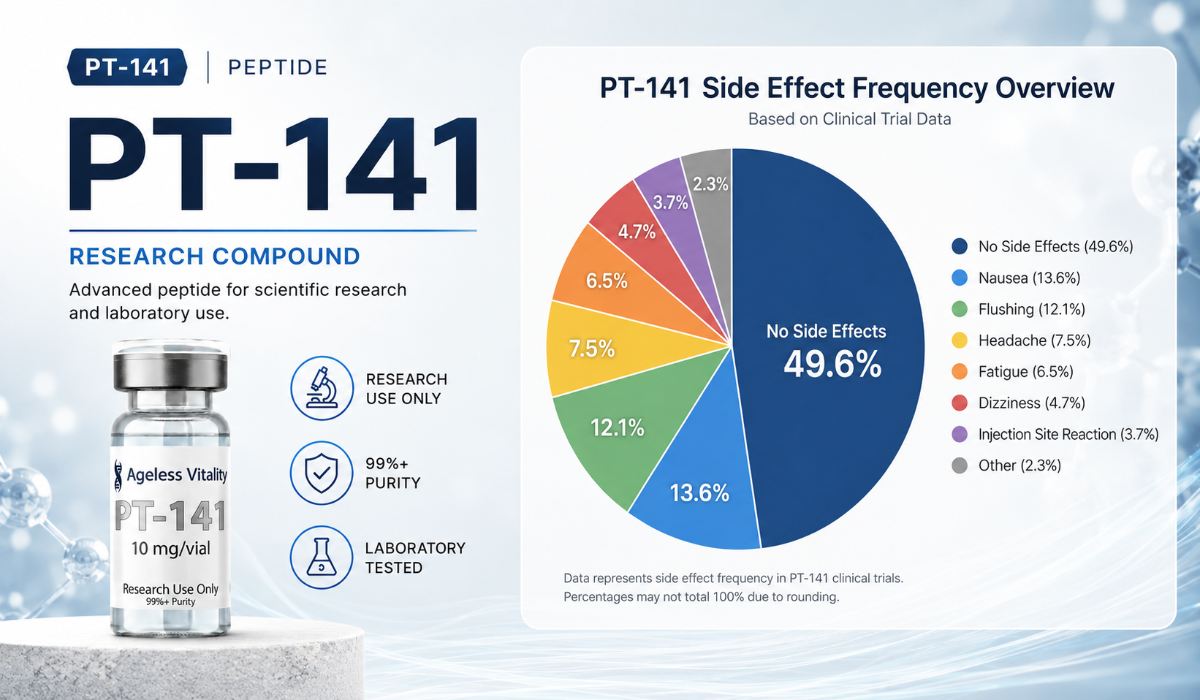
One of the most discussed aspects of PT-141 in research circles is its distinctive side effect profile largely transient and well-characterized across clinical trials.
| Side Effect | Frequency (from trial data) | Characteristics |
|---|---|---|
| Nausea | Most common (~40% of subjects) | Onset 1–2h post-dose, resolves within 2–4h |
| Flushing | Common | Facial warmth, transient |
| Headache | Moderate | Mild to moderate severity |
| Blood pressure increase | Documented | Transient systolic elevation |
| Heart rate decrease | Documented | Mild, transient bradycardia |
| Injection site reactions | Occasional | Local redness, bruising |
| Hyperpigmentation | Rare with low doses | More common with higher doses/frequency |
Cardiovascular Considerations
PT-141 is associated with a transient, dose-dependent increase in blood pressure and a corresponding decrease in heart rate following administration. In clinical trials, the mean maximum systolic blood pressure increase was approximately 6 mmHg, typically occurring 12 hours post-injection and resolving within 12 hours.
For this reason, research protocols have excluded subjects with:
- Uncontrolled hypertension
- Established cardiovascular disease
- History of myocardial infarction or stroke
The cardiovascular monitoring protocol used in FDA approval trials required blood pressure measurement before and after administration, establishing a safety baseline that researchers in any context should consider.
Nausea Management in Research Protocols
In clinical trial settings, pre-treatment with antiemetic agents (such as ondansetron) was used in some protocols to manage nausea without affecting PT-141’s primary outcomes. This approach reduced discontinuation due to nausea and improved protocol compliance.
How PT-141 Compares to Other Peptides in the Research Space
PT-141 vs. Semax and Selank: Neurological Peptide Overlaps
PT-141, Semax, and Selank all operate within the neuropeptide domain, each targeting distinct but occasionally overlapping receptor systems. Where PT-141 focuses on melanocortin pathways for sexual motivation, Semax’s benefits extend to BDNF modulation and cognitive enhancement. Selank targets anxiolytic mechanisms via enkephalin pathways.
| Peptide | Primary Target | Primary Research Application |
|---|---|---|
| PT-141 | MC3R, MC4R (hypothalamus) | Sexual motivation, HSDD research |
| Semax | BDNF, ACTH analogue | Cognitive enhancement, neuroprotection |
| Selank | Enkephalin system | Anxiolytic, stress research |
Researchers studying the intersection of stress, sexual function, and neuropeptide modulation may find these compounds relevant in combination research, though such protocols require rigorous independent safety review. For a deeper dive into Semax, see the Semax Peptide Benefits.
PT-141 vs. Metabolic Peptides: Different Categories Entirely
It’s worth distinguishing PT-141 from the metabolic research peptides that dominate much of the current landscape. Compounds like Retatrutide 10mg and Tirzepatide 10mg target GLP-1/GIP/glucagon receptors for metabolic and weight-related research. These are physiologically and mechanistically unrelated to PT-141.
However, researchers noting the hypothalamic overlap where both metabolic hormones and melanocortin receptors converge may find interesting crosstalk dynamics worth investigating in preclinical models. For researchers exploring metabolic peptide science, the Retatrutide vs Tirzepatide comparison provides useful context.
PT-141 and Recovery Peptides: Understanding the Full Research Stack
For researchers building comprehensive peptide research frameworks, PT-141 Peptide occupies a distinct lane from recovery and tissue repair peptides. Compounds like BPC-157 (5mg) and TB-500 (Thymosin Beta-4) are extensively studied for their tissue-healing, anti-inflammatory, and regenerative properties. The BPC-157 and TB-500 research overview is a useful companion resource for understanding how these compounds are studied together.
PT-141 Reconstitution and Storage: Research Protocol Essentials
Reconstituting PT-141 for Research Use
PT-141 Peptide is supplied as a lyophilized (freeze-dried) white powder in sealed research vials. For laboratory use, researchers reconstitute with bacteriostatic water, which contains 0.9% benzyl alcohol as a preservative, thereby extending the shelf life of the reconstituted solution.
Standard reconstitution process documented in research literature:
- Allow the vial to reach room temperature before opening
- Use a sterile alcohol swab on both the peptide vial and the bacteriostatic water vial
- Draw the calculated volume of bacteriostatic water into a syringe
- Inject slowly along the side of the vial avoid injecting directly onto the peptide powder
- Gently swirl (do not shake) until fully dissolved
- The reconstituted solution should be clear and colorless
Storage Guidelines
| State | Temperature | Duration |
|---|---|---|
| Lyophilized (unopened) | 2–8°C (refrigerator) | 24+ months |
| Lyophilized (long-term) | -20°C (freezer) | 36+ months |
| Reconstituted | 2–8°C | Up to 30 days |
| Reconstituted | Room temperature | Not recommended |
Avoid repeated freeze-thaw cycles. Keep away from direct light. Use amber vials or cover clear vials with foil during storage.
PT-141 in the Context of Broader Peptide Research Science
The Melanocortin System: A Research Frontier
The melanocortin system comprising five receptors (MC1R-MC5R) is among the most actively studied receptor families in contemporary pharmacology. Beyond PT-141 Peptide applications in sexual motivation research, MC4R is under active investigation for:
- Obesity and energy homeostasis — MC4R knockout mice display severe obesity, establishing the receptor’s critical role in metabolic regulation
- Inflammation modulation — MC3R has been implicated in anti-inflammatory signaling
- Neuropsychiatric research — dopaminergic crosstalk with melanocortin pathways intersects with addiction, reward, and mood research
This makes PT-141 Peptide not only relevant to sexual health research but also a probe compound for understanding the broader melanocortin system in preclinical studies.
Peptide Science and the 2026 Research Landscape
The peptide research space in 2026 has matured significantly. Researchers now approach peptide science with increasingly sophisticated frameworks distinguishing between receptor-specific agonists, peptide blends, and signaling cascade modulators. Resources like the Peptide Sciences Complete Research Guide and the Best Peptides for Fat Loss overview reflect how the field has organized itself across multiple research domains.
PT-141’s position within this landscape is clear: it is the premier melanocortin receptor agonist for research into centrally-mediated sexual arousal pathways with the credibility of FDA approval and a robust clinical trial record.
For researchers interested in exploring natural peptide analogs and endogenous signaling context, the Natural Peptides overview provides useful background on how synthetic peptides like PT-141 Peptide relate to endogenous melanocortin ligands.
Who Should NOT Be Included in PT-141 Research Protocols
Based on clinical trial exclusion criteria and published safety data, the following subject characteristics are associated with increased risk:
- Uncontrolled hypertension (systolic >145 mmHg or diastolic >95 mmHg at baseline)
- Established cardiovascular disease (coronary artery disease, heart failure)
- History of MI or stroke
- Concurrent use of antihypertensive medications requiring careful monitoring
- Postmenopausal status (outside the FDA-approved indication)
- Liver or renal impairment (altered pharmacokinetics)
- Active psychiatric conditions affecting sexual function interpretation
These exclusion criteria were developed through the clinical trial process and reflect the safety profile characterized across thousands of research subjects. Any research protocol involving PT-141 Peptide must apply rigorous inclusion/exclusion criteria consistent with this literature.
Where to Source Research-Grade PT-141 in 2026
Quality Markers for Research Peptides
The quality of research-grade peptides varies significantly across suppliers. Researchers should evaluate suppliers based on:
- Certificate of Analysis (CoA) — third-party verified purity data
- HPLC testing — high-performance liquid chromatography confirming peptide identity and purity
- Mass spectrometry — molecular weight confirmation
- GMP-adjacent manufacturing practices
- Transparent sourcing and laboratory provenance
Ageless Vitality Peptides PT-141 10mg
Ageless Vitality Peptides offers PT-141 Peptide 10mg as a research-grade lyophilized peptide vial. The compound is intended solely for laboratory and research applications, not for human use or patient administration.
Ageless Vitality Peptides is a chemical supplier not a compounding pharmacy (as defined under 503A of the Federal Food, Drug, and Cosmetic Act) and not an outsourcing facility (as defined under 503B). All products are supplied as chemical reagents for research purposes only.
Researchers looking to explore a broader array of research peptides can review the Best Peptides resource, which covers the leading compounds across multiple research categories.
PT-141 Key Research Facts: Rapid Reference
10 Things Researchers Should Know About PT-141
- PT-141 Peptide is the only melanocortin receptor agonist with FDA approval for sexual dysfunction (in women, as Vyleesi)
- It acts centrally on the brain, not peripherally on blood vessels making it mechanistically distinct from all PDE-5 inhibitors
- Its primary targets are MC3R and MC4R in the hypothalamus
- Clinical trials involved 1,200+ premenopausal women, providing a robust safety and efficacy dataset
- The most common side effect is transient nausea, observed in approximately 40% of subjects
- PT-141 produces a temporary, dose-dependent increase in blood pressure (~6 mmHg systolic)
- Effects onset within 45–60 minutes and can persist 12–24 hours
- The compound was derived from Melanotan II, with the pigmentation mechanism removed
- PT-141 has no significant interaction with the PDE-5 enzyme it works through an entirely different pathway
- Research-grade PT-141 is available as a lyophilized powder requiring reconstitution with bacteriostatic water
Conclusion:
PT-141 (Bremelanotide) is not a peripheral compound or a trend-driven research curiosity. It is a clinically validated, FDA-approved melanocortin receptor agonist with a robust preclinical and clinical research base supporting its distinct mechanism and unique application domain.
For researchers exploring neuropeptide science, melanocortin receptor pharmacology, or the physiology of sexual function, PT-141 Peptide is among the most well-characterized research compounds available. Its central mechanism acting upstream of desire itself, at the level of hypothalamic receptor activation distinguishes it fundamentally from every other compound in the sexual health research space.
Whether you are reviewing its literature for academic purposes, building a research protocol, or comparing it with other neuropeptides in your catalog, PT-141 Peptide warrants careful study. The science is solid. The clinical record is substantial. And the questions it opens about the neural architecture of desire, the melanocortin system’s role in behavior, and the future of centrally-acting pharmacology remain among the most compelling in contemporary peptide science.
For research-grade PT-141 10mg and a full catalog of premium research peptides, visit Ageless Vitality Peptides.
Frequently Asked Questions (FAQs)
What is PT-141 Peptide used for in research?
PT-141 Peptide (Bremelanotide) is studied as a melanocortin receptor agonist with applications in sexual motivation research, HSDD physiology, and central nervous system neuropeptide signaling. It is FDA-approved as Vyleesi for HSDD in premenopausal women.
How is PT-141 different from Viagra or Cialis?
PT-141 works on the brain’s melanocortin receptor system to stimulate desire at a neurological level. Viagra and Cialis (PDE-5 inhibitors) work peripherally by increasing blood flow to genital tissue. PT-141 does not require sexual stimulation to initiate a response and does not interact with the PDE-5 enzyme at all.
What are the side effects of PT-141 in clinical trials?
The most commonly documented side effects include nausea (~40% of subjects), flushing, headache, and a transient increase in systolic blood pressure. Most side effects resolve within 2–12 hours of administration.
Can men use PT-141 Peptide in research contexts?
While FDA approval is specifically for premenopausal women with HSDD, Phase II clinical research in men documented erections produced by PT-141 Peptide in the absence of external stimulation evidence of its central mechanism of action. Off-label and research use in male sexual dysfunction has been documented in the scientific literature.
How long do PT-141 effects last?
Based on clinical trial data, PT-141’s primary effects onset at 45–60 minutes and typically last 6–12 hours, with some subjects reporting effects lasting up to 24 hours.
Does PT-141 affect blood pressure?
Yes, Clinical trials documented a mean transient increase in systolic blood pressure of approximately 6 mmHg, with a corresponding decrease in heart rate. Individuals with cardiovascular conditions were excluded from trials for this reason.
Where can researchers source PT-141 Peptide?
Research-grade PT-141 Peptide 10mg is available from Ageless Vitality Peptides as a lyophilized chemical reagent for laboratory research purposes only.