What Is MOTS-c? Mechanism, Structure and Research

MOTS-c is a 16-amino-acid mitochondrial-derived peptide (MDP) encoded within the mitochondrial genome’s 12S rRNA region, first identified and characterized by researchers at the University of Southern California in 2015. Unlike peptides derived from nuclear DNA, MOTS-c originates directly from mitochondrial genetic material, positioning it as a signaling molecule of specific interest in mitochondrial biology and cellular metabolism research.
Since its discovery, published research including the original characterization study in Cell Metabolism has identified MOTS-c as part of a broader class of mitochondrial-derived peptides that appear to play a role in retrograde communication between mitochondria and the nucleus. This positions MOTS-c within an active and expanding area of peptide science, where researchers continue to investigate its structural properties, its proposed mechanism of action, and its relevance to cellular stress response pathways.
This guide breaks down what MOTS-c is at a structural level, how it’s proposed to function within the cell, and what the current body of published and ongoing research says for researchers and laboratory professionals evaluating the compound within a strictly non-clinical, research-use-only context. Researchers new to sourcing standards and verification practices may also find our peptide sciences research guide a useful starting point.
What Is MOTS-c?
MOTS-c (Mitochondrial Open Reading Frame of the 12S rRNA type-c) is a small peptide made up of 16 amino acids that is encoded within mitochondrial DNA rather than the cell’s nuclear genome. This distinction matters in research contexts because it places MOTS-c in a small but growing category of mitochondrial-derived peptides (MDPs) that researchers believe may function as messengers between the mitochondria and the rest of the cell.
A Mitochondrial-Derived Peptide (MDP) Overview
Mitochondrial-derived peptides are a class of molecules that originate from short open reading frames within mitochondrial DNA, distinguishing them from the vast majority of cellular proteins that are encoded by nuclear DNA. MOTS-c belongs to this category alongside other identified MDPs such as humanin, though it is structurally and functionally distinct from them. In the research literature, MOTS-c is most often studied in the context of mitochondrial-to-nuclear communication the idea that mitochondria are not just energy-producing organelles but active participants in cellular signaling. This reframes mitochondria, in a research context, as components with a broader regulatory role in cell biology than previously understood.
This mitochondrial-to-nuclear communication research also overlaps with broader interest in longevity-focused compounds such as GHK-Cu and NAD+, both of which are studied for related roles in cellular aging and metabolic regulation.
Discovery and Genetic Origin (12S rRNA Region)
MOTS-c was first identified and characterized in 2015 by a research team at the University of Southern California, who published their findings in Cell Metabolism. The peptide’s genetic origin traces to a short open reading frame located within the 12S ribosomal RNA (rRNA) region of the mitochondrial genome a segment of DNA not previously known to encode a functional peptide. This discovery was notable because it expanded the understood coding capacity of mitochondrial DNA, which had long been considered fully mapped for protein-coding purposes. The identification of MOTS-c within this region has since prompted continued research into whether other uncharacterized segments of the mitochondrial genome may also encode biologically active peptides.
MOTS-c Peptide Structure and Sequence
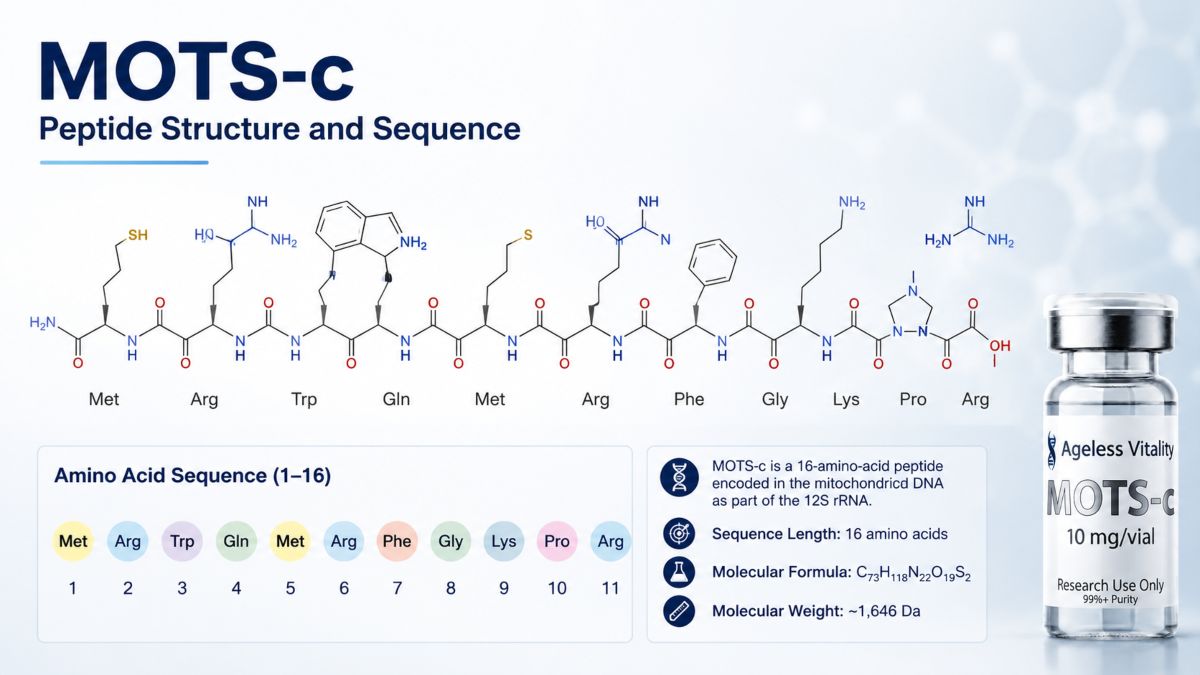
MOTS-c is a 16-amino-acid peptide with a defined sequence that has been consistently characterized across published research since its 2015 discovery. Its structure is what allows researchers to distinguish it from other mitochondrial-derived peptides and to study its properties in isolation from broader mitochondrial function.
Amino Acid Sequence Breakdown
The MOTS-c sequence consists of 16 amino acid residues, translated from a short open reading frame within the mitochondrial 12S rRNA gene. Its molecular formula and sequence have been documented in peptide databases and research repositories, providing researchers with a consistent reference point for sourcing, verifying synthesis, and replicating experiments. Because the peptide is short relative to many other bioactive peptides, MOTS-c is easier to synthesize with high purity, which is one reason it has become accessible for laboratory-scale research. Sequence accuracy is a key quality marker in this space researchers typically verify peptide identity through mass spectrometry and HPLC analysis before use in any experimental protocol.
Molecular Characteristics
Beyond its raw sequence, MOTS-c’s molecular characteristics including its estimated molecular weight and solubility profile inform how it is handled and stored in a laboratory setting. As a small peptide, MOTS-c shares general handling considerations common to other short-chain research peptides, including sensitivity to temperature and the need for proper reconstitution and storage protocols to preserve structural integrity for experimental use.
Researchers studying MOTS-c typically source it in lyophilized (freeze-dried) form, which extends shelf stability before use in a research setting, and often pair it with a dedicated reconstitution solution such as VitalPrep Sterile Solution to help preserve peptide integrity during preparation. This structural profile a short, well-defined sequence with high synthesis fidelity is part of what has made MOTS-c a practical candidate for continued mitochondrial signaling research since its identification.
MOTS-c Mechanism of Action
MOTS-c’s proposed mechanism of action centers on its ability to transmit signals from mitochondria to the nucleus, positioning it as a regulator of cellular metabolic responses rather than a simple structural or enzymatic molecule. Research to date suggests this mechanism operates through several interconnected pathways.
Mitochondrial-to-Nuclear Retrograde Signaling
The defining feature of MOTS-c’s proposed mechanism is retrograde signaling communication that flows from mitochondria to the nucleus, rather than the more commonly studied nuclear-to-mitochondrial signaling. Published research indicates that under conditions of cellular stress, MOTS-c translocates to the nucleus, where it is proposed to interact with nuclear transcription factors and influence the expression of genes involved in metabolic regulation and antioxidant response. This retrograde signaling model is significant in mitochondrial biology because it suggests mitochondria are not passive energy producers but active participants that can adjust nuclear gene expression in response to the cell’s metabolic state.
Cellular Stress Response Pathway
MOTS-c has been studied for its apparent role in the cellular stress response, particularly under conditions such as metabolic or oxidative stress. Research published in Cell Metabolism and subsequent studies has proposed that MOTS-c levels and activity shift in response to cellular stressors, supporting the hypothesis that it functions as part of a broader mitochondrial surveillance system. This positions MOTS-c within the same research territory as other stress-responsive signaling peptides, though its specific upstream triggers and downstream targets remain an active area of ongoing investigation.
AMPK Pathway Interaction
A substantial portion of MOTS-c research has focused on its interaction with AMPK (AMP-activated protein kinase), a central regulator of cellular energy homeostasis. Studies have shown that MOTS-c activates AMPK signaling, which, in turn, influences cellular processes related to glucose uptake and metabolic regulation. This AMPK interaction is one of the most frequently cited mechanistic findings in the MOTS-c literature. It is a primary reason the peptide has attracted sustained research interest in metabolic science. This same interest in glucose and energy regulation places MOTS-c alongside other metabolically focused research compounds such as GLP-1 S, GLP-2 T, and GLP-3 RT, as well as Tesamorelin, all of which are studied for related aspects of metabolic and energy homeostasis research.
Current Research and Published Studies
Current published research on MOTS-c spans metabolic regulation, cellular stress response, and exercise physiology, with a growing body of literature indexed across major scientific databases since its 2015 discovery. This research base provides scientists with a reference point for distinguishing what has been substantiated from what remains hypothesis-driven.
Key Findings in Published Literature
The foundational study on MOTS-c, published in Cell Metabolism by Kim, Lee, and colleagues, established its identification, sequence, and initial mechanistic insights into metabolic homeostasis. Since that original publication, follow-up studies have expanded into areas including its interaction with AMPK signaling, its behavior under metabolic stress conditions, and its potential relevance to age-related changes in mitochondrial function. A number of these studies have also explored MOTS-c in the context of exercise physiology, examining how circulating peptide levels shift in response to physical activity in animal and cell-based models.
Researchers interested in the muscle and recovery side of peptide science may also find our best peptides for muscle growth research overview relevant, alongside compounds such as the CJC-1295 + Ipamorelin Blend, TB-500, and BPC-157, which are frequently studied in adjacent recovery and performance research contexts. Collectively, this body of work has helped position MOTS-c as one of the more extensively studied mitochondrial-derived peptides within this research category.
PubMed-Indexed Research Overview
A PubMed search for “MOTS-c” returns a body of peer-reviewed studies spanning multiple research institutions and countries, reflecting sustained international interest in the peptide since its characterization. This indexed literature includes original research articles, mechanistic studies, and review papers that synthesize findings across the field. For researchers evaluating MOTS-c, PubMed remains the most reliable starting point for accessing peer-reviewed, citable sources rather than relying on secondary summaries, given that primary literature is the standard for verifying methodology and findings in peptide research.
Clinical Trial Landscape
Human clinical research on MOTS-c is at an early stage compared to its preclinical research, with most available data still from cell-based and animal studies rather than large-scale human trials. This gap between preclinical and clinical research is common for recently characterized peptides and is an important distinction for researchers to understand when evaluating the current state of the science.
Human Trial Status and Scope
While MOTS-c has been the subject of registered early-phase human research, the overall volume of completed, peer-reviewed clinical trial data remains limited relative to the extensive preclinical literature on its mechanism and metabolic effects. Early-phase trials that have been conducted or registered have generally focused on safety, tolerability, and pharmacokinetics rather than efficacy for any specific condition. Researchers evaluating MOTS-c should treat clinical-stage findings as preliminary, given that this area of the research pipeline is still developing relative to the peptide’s decade of preclinical characterization.
Research Institutions Involved
MOTS-c research has drawn participation from academic institutions and research groups across the United States and internationally, with the University of Southern California continuing to be closely associated with foundational work on the peptide since its original 2015 identification. Beyond academic settings, interest in MOTS-c has also extended into private research and biotechnology contexts, where it is being explored for its metabolic signaling properties.
This broader private-sector interest in metabolic peptide research is also reflected in compounds like AOD-9604, which researchers frequently evaluate in our overview of the best peptides for fat loss. This distributed research interest across both academic and private sectors is one indicator of the peptide’s sustained relevance within mitochondrial and metabolic science, even as clinical-stage data continues to accumulate.
Latest MOTS-c Research (2025–2026)
Recent MOTS-c research has moved beyond foundational mechanistic work into more targeted metabolic and cardiac applications, alongside a shifting regulatory and anti-doping landscape that researchers should be aware of when evaluating the compound’s current standing.
Emerging Research Directions
A 2025 study published in Frontiers in Physiology examined MOTS-c’s potential to restore mitochondrial respiration in the type 2 diabetic heart, building on its established role in energy homeostasis and muscle function within metabolic disease models. This reflects a broader trend in recent literature toward applying MOTS-c research specifically to cardiometabolic and diabetic disease models rather than general mitochondrial signaling alone. On the human trial side, a MOTS-c analog compound, CB4211, completed Phase 1 testing, showing safety and reductions in liver-related markers in obese subjects with fatty liver disease. However, Phase 2 development of that compound was subsequently discontinued.
Separately, newer trial activity has emerged: MOTS-c has entered Phase 2a human trials targeting prediabetes, with results anticipated in late 2026 to early 2027 representing one of the more advanced human research efforts involving MOTS-c to date. This mirrors trial and comparative research activity around other metabolically active compounds, where researchers have published detailed comparisons such as our GLP-3 RT vs GLP-2 T research overview and duration data like how long 10mg of GLP-3 RT lasts in a research setting.
Regulatory attention has also increased: MOTS-c was added to the World Anti-Doping Agency’s Prohibited List in 2024, categorized due to its exercise-mimetic, AMPK-activating properties, an indication that its physiological effects observed in preclinical exercise research are being taken seriously in applied regulatory contexts.
Open Questions for Future Study
Despite this expanding research base, significant open questions remain before MOTS-c’s mechanisms can be considered clinically established. As of March 2026, no completed large-scale human clinical trials have been conducted, and therapeutic claims remain preclinical. Delivery remains an unresolved technical challenge as well: reliable delivery systems for mitochondrial-derived peptides like MOTS-c are still lacking, which continues to limit clinical translation of otherwise strong preclinical findings a challenge also documented in delivery-sensitive research compounds such as IGF-1 LR3 and Sermorelin.
Researchers also continue to investigate dosing thresholds, long-term safety in human populations, and how findings from rodent models will translate to human metabolic and cardiac applications questions that the ongoing Phase 2a prediabetes trial may begin to address once results are published. Until that data matures, MOTS-c remains firmly in the research and preclinical category rather than an established human therapeutic.
Related Research Peptides
Researchers exploring MOTS-c’s role in cellular repair and mitochondrial signaling may also find value in our peptides for skin research overview, as well as compounds such as the BPC-157 + TB-500 Blend, which is frequently studied in adjacent tissue-repair research contexts.
Beyond metabolic and mitochondrial research, MOTS-c is sometimes discussed alongside other systemic research peptides studied for distinct biological pathways, including Semax and Selank compared directly in our Semax vs. Selank research overview as well as PT-141 and Thymosin Alpha-1, each evaluated in separate areas of peptide science.
Researchers building out a broader mitochondrial and metabolic research panel alongside MOTS-c frequently reference compounds such as Epithalon, Melanotan II, and HCG, each associated with a distinct area of preclinical investigation.
Research Use Only Disclosure
All MOTS-c products offered through Ageless Vitality Peptides are sold strictly as chemical reagents for laboratory and research purposes and are not intended for human use, consumption, or clinical application. This distinction is foundational to how the compound is offered and should be understood by anyone evaluating MOTS-c for research purposes.
Ageless Vitality Peptides is not a compounding pharmacy under Section 503A, nor an outsourcing facility under Section 503B, and does not sell products to patients or for patient-directed use. As a chemical reagent supplier, all products including MOTS-c are provided exclusively to qualified researchers, laboratories, and institutions for in vitro and preclinical research applications. Nothing offered is intended to diagnose, treat, cure, or prevent any disease, and no statement on this page or elsewhere on this site should be interpreted as a health claim, medical recommendation, or endorsement of human use.
Researchers are responsible for ensuring their use of any research compound complies with all applicable local, state, and federal regulations governing research chemicals. All information provided throughout this article reflects published scientific literature and is intended for educational and research reference purposes only.
Frequently Asked Questions (FAQs)
What is MOTS-c?
MOTS-c is a 16-amino-acid mitochondrial-derived peptide (MDP) encoded within the mitochondrial genome’s 12S rRNA region. It was first identified and characterized by researchers at the University of Southern California in 2015.
How is MOTS-c different from peptides encoded by nuclear DNA?
Most cellular proteins are encoded by nuclear DNA, but MOTS-c originates directly from a short open reading frame within mitochondrial DNA. This distinction places it in a small, growing category of mitochondrial-derived peptides believed to function as messengers between the mitochondria and the rest of the cell.
What is MOTS-c’s proposed mechanism of action?
Research proposes that MOTS-c functions through retrograde signaling — communication that flows from the mitochondria to the nucleus. Under conditions of cellular stress, it’s proposed to translocate to the nucleus and interact with transcription factors involved in metabolic regulation and antioxidant response.
How does MOTS-c relate to AMPK?
A substantial portion of MOTS-c research focuses on its interaction with AMPK (AMP-activated protein kinase), a central regulator of cellular energy homeostasis. Studies propose that MOTS-c activates AMPK signaling, influencing processes tied to glucose uptake and metabolic regulation.
Has MOTS-c been studied in human clinical trials?
Human trial research remains at an early stage relative to the preclinical literature. Most available data still comes from cell-based and animal studies. A MOTS-c analog, CB4211, completed Phase 1 testing, and MOTS-c itself has entered Phase 2a trials targeting prediabetes, with results anticipated in late 2026 to early 2027.
Why was MOTS-c added to WADA’s Prohibited List?
MOTS-c was added to the World Anti-Doping Agency’s Prohibited List in 2024 due to its exercise-mimetic, AMPK-activating properties observed in preclinical research.
What open questions remain in MOTS-c research?
As of March 2026, no completed large-scale human clinical trials have been conducted. Reliable delivery systems for mitochondrial-derived peptides remain an unresolved technical challenge, and researchers continue to investigate how findings from rodent models will translate into human applications.
Is MOTS-c available for human use?
No, MOTS-c products offered through Ageless Vitality Peptides are sold strictly as chemical reagents for laboratory and research purposes, not for human use, consumption, or clinical application. AVP is not a compounding pharmacy or an outsourcing facility, and it does not sell to patients.