Bacteriostatic Water vs Sterile Water for Peptides | Key Differences for Research Use
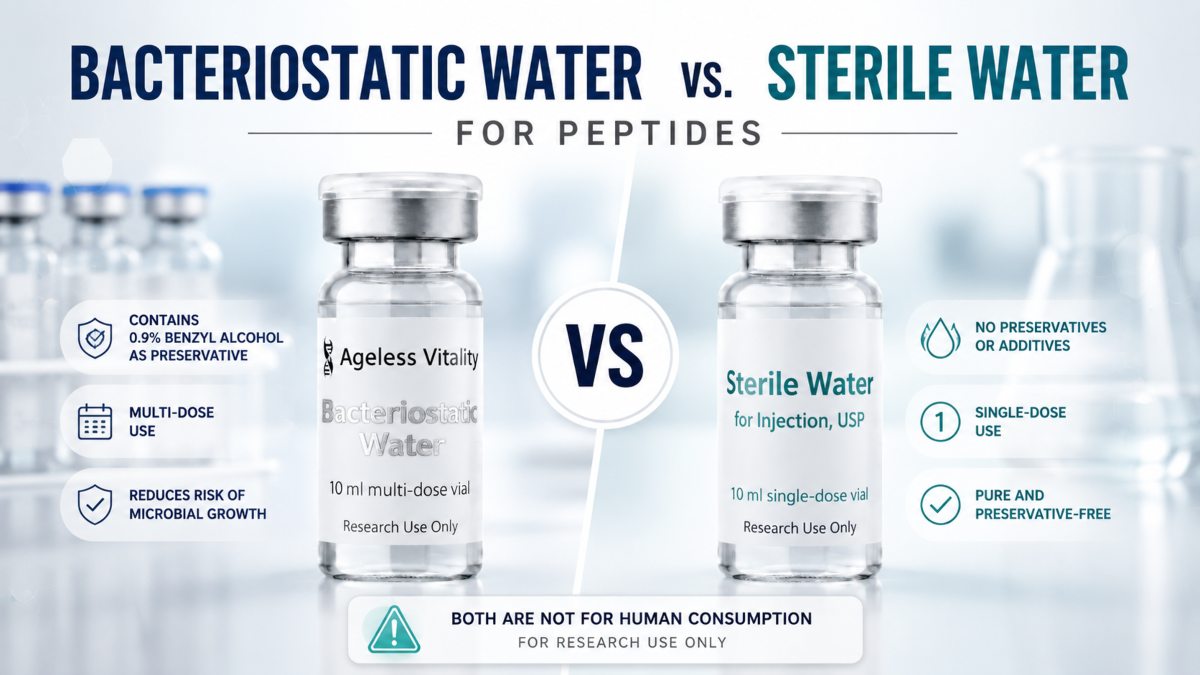
Bacteriostatic Water vs Sterile Water for Peptides are both pharmaceutical-grade diluents. Still, they aren’t interchangeable for peptide reconstitution: bacteriostatic water contains 0.9% benzyl alcohol as a preservative, allowing multidose vials to remain usable for up to 28 days, while sterile water has no preservatives and must be used immediately after opening.
If you’ve ordered peptides and aren’t sure which mixing solution to grab, this distinction matters more than most guides let on. The wrong choice doesn’t just affect convenience it can impact how long your peptide vial stays viable, whether bacterial growth becomes a risk, and in rare cases, whether the preservative itself interacts poorly with certain peptide compounds.
This guide breaks down exactly what each solution is, how they differ, when the terms get confused with “reconstitution solution,” and which one fits your specific situation whether you’re working with a single-use vial or one you’ll draw from repeatedly over several weeks. If you’re new to the process entirely, our guide how to reconstitute peptides is a useful starting point before diving into the solution comparison.
What Is Bacteriostatic Water?
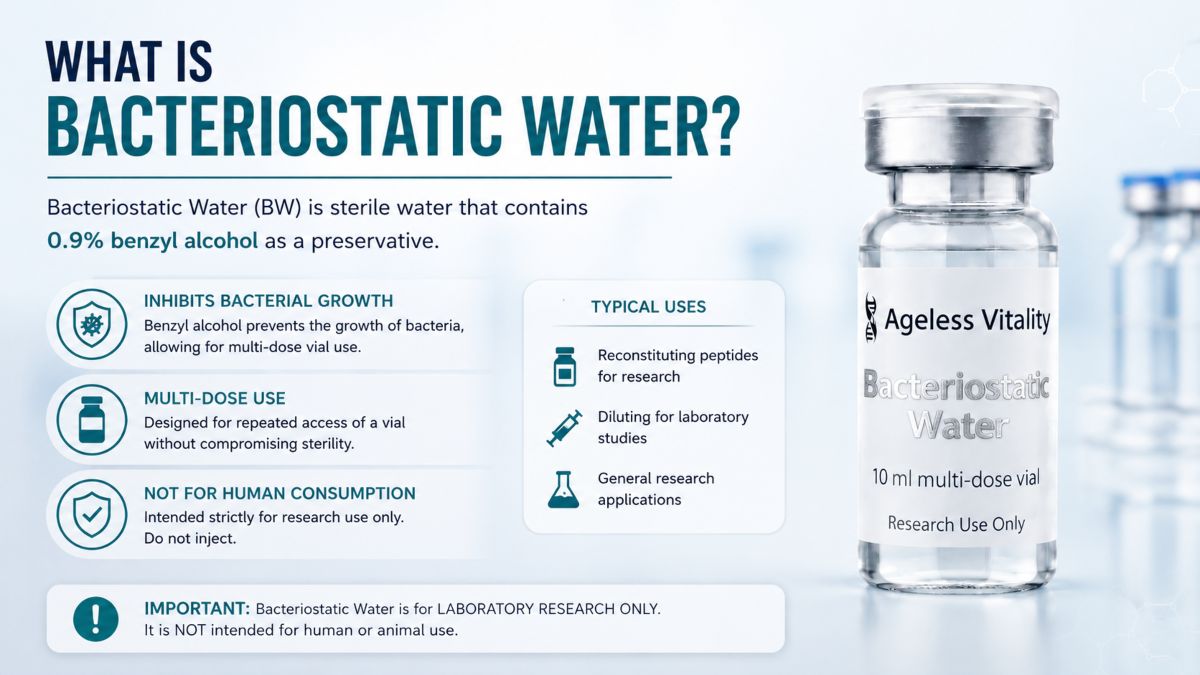
Bacteriostatic water is sterile water infused with 0.9% benzyl alcohol. This preservative inhibits bacterial growth, allowing the solution to be drawn from multiple times without contaminating the vial. This makes it the standard diluent for reconstituting peptides that will be used over several days or weeks rather than all at once.
How It’s Made (Benzyl Alcohol Preservative)
Bacteriostatic water is sterile water for injection that is mixed with 0.9% benzyl alcohol and packaged in sealed, sterile vials. The benzyl alcohol doesn’t kill existing bacteria instead, it slows or prevents new bacterial growth each time the rubber stopper is punctured. This is why a bacteriostatic water vial, once opened, typically remains safe to use for up to 28 days when stored properly in a refrigerator. In contrast, sterile water should be discarded after a single use.
Common Uses in Peptide Reconstitution
Bacteriostatic water is the go-to choice for reconstituting peptides intended for multi-dose use, such as those drawn from the same vial daily over a course of weeks. Because the preservative protects the solution between uses, it reduces the risk of bacterial contamination from repeated needle insertions. It’s widely used across research and clinical settings precisely because it bridges a practical gap: most peptide vials contain more product than a single dose, and bacteriostatic water makes it safe to store and use that vial incrementally rather than wasting unused peptide. Our 10ml bacteriostatic water is pharmaceutical-grade and sized to pair conveniently with standard peptide vials.
What Is Sterile Water?
Sterile water is water that has been purified and processed to be completely free of bacteria, viruses, and other microorganisms, with no additives of any kind. Unlike bacteriostatic water, it contains no preservatives, which means it’s intended for immediate, single-use applications only.
How It’s Made (No Preservatives)
Sterile water is produced by distillation or reverse osmosis and then sterilized, typically by autoclaving, to eliminate microbial contamination. The result is pure H2O with nothing else added no benzyl alcohol, no buffers, no preservatives of any kind. This purity is exactly why sterile water has such a short usability window. Once the vial’s seal is broken and the sterile environment is compromised, there’s nothing in the solution to prevent bacterial growth. Most sterile water vials are labeled single-use only, with any unused portion discarded after opening, often within hours.
Common Medical and Lab Uses
Sterile water serves as a base diluent across a wide range of medical and laboratory applications, from diluting injectable medications to rinsing wounds and preparing solutions for IV administration. In peptide reconstitution, sterile water is sometimes preferred when a peptide is sensitive to preservatives, as benzyl alcohol can occasionally interact with certain compounds or cause irritation in sensitive individuals. However, because it lacks any antimicrobial protection, sterile water is best suited for peptides that will be used in their entirety shortly after mixing, rather than stored and drawn from over time.
Bacteriostatic Water vs Sterile Water: Key Differences
The core difference between bacteriostatic water and sterile water comes down to one ingredient: benzyl alcohol. Bacteriostatic water contains 0.9% benzyl alcohol as a preservative, making it suitable for multidose use, while sterile water contains nothing but purified H2O and is meant for single-use only.
Composition Differences
Sterile water is simply purified and sterilized water, with no additives. Bacteriostatic water is made from the same sterile base but contains 0.9% benzyl alcohol added during manufacturing. This small compositional difference is the sole reason the two solutions behave so differently after the vial is opened the benzyl alcohol acts as a built-in defense against bacterial contamination whenever the stopper is pierced.
Shelf Life After Opening
This is where the practical impact becomes clear. A vial of bacteriostatic water can typically be used for up to 28 days after opening when refrigerated, because the benzyl alcohol continues to suppress bacterial growth between uses. Sterile water, by contrast, has no such protection once opened, it’s generally recommended for immediate, single-use only, with any leftover discarded the same day. For anyone reconstituting a peptide they plan to use over several weeks such as BPC-157, TB-500, or CJC-1295/Ipamorelin this difference alone often decides which solution makes sense.
Safety Considerations for Repeated Use
Repeatedly piercing a vial with a needle introduces a small risk of bacterial contamination each time, regardless of which water is used. Bacteriostatic water’s preservative is specifically designed to manage this risk over multiple draws, which is why it’s the standard choice for multi-dose peptide vials. Using sterile water for repeated draws over an extended period increases the risk of bacterial growth in the vial, as the solution contains nothing to inhibit it. That said, some individuals are sensitive to benzyl alcohol, so for single-use peptide preparations or for those with a known sensitivity, sterile water remains the appropriate and safer option.
Is Bacteriostatic Water the Same as Sterile Water?
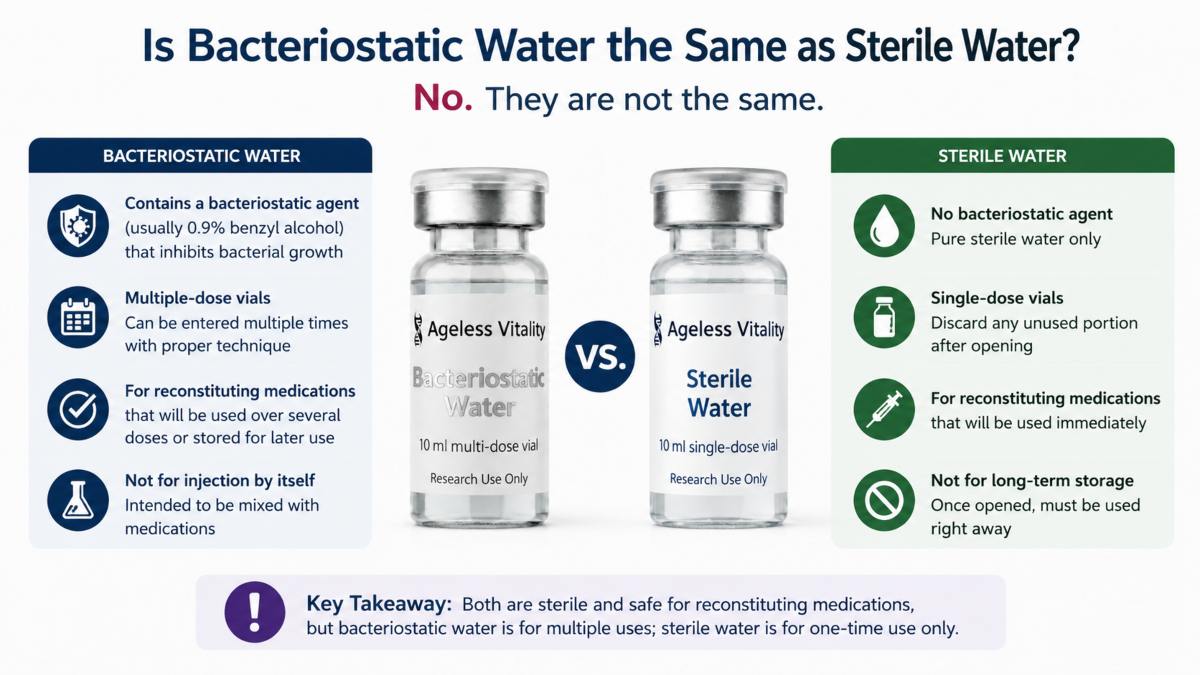
No, bacteriostatic water is not the same as sterile water, though the two are frequently confused because both start from the same purified, sterilized base. The key distinction is that bacteriostatic water contains 0.9% benzyl alcohol as a preservative, while sterile water contains nothing.
Why They’re Often Confused
The confusion is understandable: both solutions look identical, come in similar small vials, and are technically “sterile water” at their core. Packaging and labeling don’t always make the distinction obvious to a casual reader, and the terms get used loosely in conversation, online forums, and even some product listings. Additionally, both solutions serve overlapping roles as diluents, making it easy to assume they’re functionally interchangeable. In reality, that one added ingredient benzyl alcohol is what separates a vial meant for weeks of repeated use from one meant to be used once and discarded.
Side-by-Side Comparison Table
| Feature | Bacteriostatic Water | Sterile Water |
|---|---|---|
| Preservative | 0.9% benzyl alcohol | None |
| Multi-dose use | Yes, typically up to 28 days (refrigerated) | No, single use only |
| Best for | Peptides used over multiple days/weeks | Peptides used immediately or sensitive to benzyl alcohol |
| Composition | Purified water + preservative | Pure purified water only |
Bacteriostatic Water vs Reconstitution Solution: Are They the Same?
Reconstitution solution and bacteriostatic water are often the same thing in practice. Still, not always the term “reconstitution solution” describes a function rather than a specific formulation, which is why the two names are used interchangeably in some contexts and mean very different things in others.
What “Reconstitution Solution” Actually Means
Reconstitution solution is a broad, functional term for any liquid used to dissolve a lyophilized (freeze-dried) compound back into a usable liquid form. It doesn’t refer to a single specific product. Depending on the compound being reconstituted and the intended use, a reconstitution solution could be bacteriostatic water, sterile water, sterile saline, or even a specially buffered solution designed for a particular peptide or medication. In the peptide community specifically, the term is sometimes used as a branded or generalized label on vials that contain bacteriostatic water, which is where much of the confusion originates the product inside may be identical, but the label reads differently.
When the Terms Are Used Interchangeably (and When They’re Not)
In most peptide reconstitution contexts, when someone refers to a “reconstitution solution,” they almost certainly mean bacteriostatic water. Many suppliers use the term on their product labeling either as a generic descriptor or to avoid regulatory friction around pharmaceutical terminology. In these cases, checking the ingredient list for 0.9% benzyl alcohol will confirm whether the product is functionally identical to standard bacteriostatic water.
However, the terms should not be treated as universal synonyms: a reconstitution solution formulated for a specific hormone or medication may contain buffers, stabilizers, or a different preservative concentration, making it unsuitable as a straight substitute for bacteriostatic water in peptide applications. When in doubt, the ingredient label not the product name is the only reliable guide. For a deeper walkthrough of the full process, see our guide on How to reconstituting peptides with bacteriostatic water.
Which One Should You Use for Peptides?
For most peptide reconstitution, bacteriostatic water is the right choice but the best answer depends on how quickly you plan to use the vial and whether the specific peptide has any known sensitivity to benzyl alcohol. Getting this decision right protects both the integrity of the peptide and the safety of repeated use.
Single-Use Vials vs Multi-Dose Vials
The intended dosing schedule is the most practical factor in choosing between the two solutions. If you’re reconstituting a peptide vial for a single session drawn once and administered in full sterile water is entirely appropriate and avoids unnecessary exposure to preservatives. But if the vial will be drawn from daily or several times a week over an extended period, bacteriostatic water is the clear choice.
Its 28-day usability window after opening is specifically designed for this use case, and using sterile water in a multi-dose context introduces a real and unnecessary contamination risk with every additional needle insertion. This applies to high-frequency protocols using peptides like Semaglutide, Retatrutide, or Sermorelin, where consistent daily or weekly dosing is the norm.
Peptide Stability and Storage Recommendations
Reconstituted peptides are sensitive to temperature, light, and chemical environment. Once a peptide is mixed with either solution, it should be stored in a refrigerator at 2–8°C and kept away from direct light. Research consistently shows that lyophilized peptides can remain stable for months or even years. Still, their stability drops significantly after reconstitution most reconstituted peptides are considered reliable for no longer than 28 days under refrigeration, which is precisely why the shelf life of bacteriostatic water aligns so well with typical peptide usage cycles. Regardless of the solution used, freezing a reconstituted peptide is generally discouraged, as it can degrade the compound’s structure.
When Sterile Water Is the Better Choice
There are specific situations where sterile water is not just acceptable but preferable. Some peptides are documented to be sensitive to benzyl alcohol, and in those cases using bacteriostatic water can reduce potency or cause degradation. Additionally, individuals with a known allergy or sensitivity to benzyl alcohol should always opt for sterile water and plan their dosing so the full vial is used in one session. Sterile water is also the appropriate choice in clinical settings where single-use protocols are required by policy. The deciding factor is always the same: if the vial will be used once, sterile water is clean, simple, and sufficient it’s only when multi-dose use comes into play that bacteriostatic water becomes the necessary standard.
Step-by-Step: How to Reconstitute Peptides Properly
Reconstituting a peptide correctly takes less than five minutes, but the technique matters improper mixing is one of the most common reasons a peptide loses potency before it’s ever used. The goal is to completely dissolve the lyophilized powder without agitation or degradation of the compound.
Tools and Supplies Needed
Before you begin, having everything ready on a clean surface reduces the risk of contamination during the process. You’ll need the peptide vial, a vial of bacteriostatic water or sterile water, two insulin syringes or a low-volume syringe, alcohol swabs, and a clean work surface. Some researchers also keep a marker on hand to label the vial with the reconstitution date. This small step matters significantly when you’re tracking a 28-day usage window across multiple vials.
Mixing Ratios and Best Practices
The most common reconstitution ratio is 1ml of bacteriostatic water per 1mg of peptide, though this varies depending on the peptide’s concentration and your preferred dosing volume. To mix, swab both vial stoppers with alcohol and allow them to dry. Draw your chosen volume of bacteriostatic water into the syringe, then insert the needle into the peptide vial and allow the liquid to run slowly down the inside wall of the vial rather than squirting it directly onto the powder.
This gentle approach preserves the peptide’s structural integrity. Once the liquid is added, swirl the vial gently between your fingers never shake it. Shaking introduces air bubbles and can break peptide bonds, reducing the compound’s effectiveness. For peptide-specific mixing guidance, our complete reconstitution walkthrough covers ratios and dosing calculations in detail.
Common Mistakes to Avoid
The most damaging mistake is forcing the reconstitution solution onto the freeze-dried powder, which can denature the peptide. A close second is shaking the vial to speed up dissolution. If the powder doesn’t dissolve immediately with gentle swirling, refrigerating the vial for 15 to 30 minutes and then swirling again is a far safer approach.
Using the wrong solution type is another frequent error: substituting tap water, saline, or an unverified liquid for pharmaceutical-grade bacteriostatic or sterile water introduces contamination risk regardless of how carefully everything else is handled. Finally, failing to label the vial with a reconstitution date is a small oversight that becomes a real problem when managing multiple peptides once reconstituted, the clock is running, and there’s no reliable way to judge freshness by appearance alone.
Final Verdict: Choosing the Right Water for Your Needs
For the vast majority of peptide users, bacteriostatic water is the preferred choice it’s safer for multi-dose use, aligns with standard 28-day peptide protocols, and is widely available. Sterile water earns its place in single-session use cases and for individuals with benzyl alcohol sensitivity, but it’s the exception rather than the rule.
The decision ultimately comes down to two questions: how many times will you draw from this vial, and does the specific peptide have any known preservative sensitivity? Answer those, and the right solution becomes obvious. If you’re still building out your peptide research stack, explore our guides on the best peptides, best peptides for fat loss, best peptides for muscle growth, and peptides for skin to find the compounds best suited to your goals and make sure you’re set up with the right reconstitution supplies before your order arrives.
Frequently Asked Questions(FAQs)
Can I Use Sterile Water Instead of Bacteriostatic Water?
Yes, but only under the right circumstances. Sterile water is a safe substitute for bacteriostatic water when the entire reconstituted vial will be used in a single session, or when the peptide being reconstituted is known to be sensitive to benzyl alcohol. Where sterile water becomes the wrong choice is in any multi-dose scenario without a preservative, each additional needle insertion introduces contamination risk that compounds over time. For daily-use peptide protocols that span days or weeks, bacteriostatic water isn’t just more convenient, it’s meaningfully safer.
How Long Does Reconstituted Peptide Last With Each Solution?
A peptide reconstituted with bacteriostatic water and stored at 2–8°C in a refrigerator is generally considered stable and usable for up to 28 days. The benzyl alcohol preservative doesn’t indefinitely extend the peptide’s stability, but it does protect the solution from bacterial contamination during that window. A peptide reconstituted with sterile water, by contrast, should be used the same day it’s mixed without any preservative, the contamination risk grows with every hour the vial sits open.
For context, the underlying lyophilized peptide can remain stable for one to two years or longer when stored correctly before reconstitution, making the post-reconstitution window the most critical and time-limited phase of the entire storage cycle. For compound-specific timing questions such as how long 10mg of Retatrutide lasts dosing frequency plays a large role alongside storage method.
Can Bacteriostatic Water Be Used for Injections Other Than Peptides?
Yes, Bacteriostatic water is a standard pharmaceutical diluent used well beyond peptide reconstitution. It’s commonly used in clinical settings to dilute medications for intramuscular, subcutaneous, and intravenous injection, including certain hormones, vitamins, and other injectable compounds. The 0.9% benzyl alcohol concentration is considered safe for repeated injection use in adults at typical dosing volumes. However, it is not recommended for use in newborns or premature infants, as neonates lack the metabolic capacity to process benzyl alcohol safely a contraindication explicitly noted in FDA guidance on benzyl alcohol toxicity in neonates.
Where Can I Buy Bacteriostatic or Sterile Water?
Both solutions are available through several legitimate channels. Bacteriostatic water is sold by licensed compounding pharmacies, medical supply retailers, and several online suppliers that cater to research and clinical use. Our pharmaceutical-grade bacteriostatic water is available in 10ml vials, properly sealed and labeled for research use. Sterile water for injection is widely available at pharmacies, often without a prescription, and through medical supply distributors. When purchasing either solution, the most important factors are pharmaceutical-grade labeling, a verifiable manufacturer, and proper sealed vial packaging any product that arrives without clear labeling, lot numbers, or expiration dates should be avoided regardless of price. Purchasing from reputable, traceable sources isn’t optional when the solution is going directly into the body.