Peptides for Longevity Research | Purity and Research Guide

Peptides for longevity research are short chains of amino acids studied in laboratory and preclinical settings for their role in cellular signaling, repair, and regeneration processes linked to aging biology. Researchers select these compounds based on purity, documented testing, and relevance to specific study models not for direct human use, but to investigate mechanisms at the cellular level.
Interest in this space has grown sharply alongside broader peptide science: one recent bibliometric analysis of peptide-related drug research found the published literature base has expanded to a final dataset of 87,611 articles spanning 28 countries and regions from 2005 to 2024, reflecting how fast peptide research as a field has scaled globally. Longevity and cellular regeneration are among the more active subfields within that broader research landscape, with academic and private labs alike sourcing research-grade peptides to study aging-related pathways in controlled environments.
This guide breaks down what “research-grade” and “pure tested” mean when sourcing peptides for this kind of work, the major categories of research under the longevity umbrella, how that research is typically structured, and what to evaluate in a supplier before selecting compounds for a study. Every section below stands on its own, so you can jump directly to what you need whether that’s purity standards, study categories, or sourcing considerations.
What Are Longevity Research Peptides?
Longevity research peptides are research-grade peptide compounds studied specifically for their involvement in cellular aging, repair, and regeneration processes sourced and used exclusively within laboratory and preclinical research settings rather than for clinical or consumer application. The category is defined by research purpose, not by any single molecule, which is why it spans several structurally distinct peptide classes.

Defining the Research Peptide Category
A research peptide is a synthesized amino acid chain manufactured to a documented purity standard and intended solely for laboratory investigation. What separates “research peptide” from other peptide products on the market is the framing around use: these compounds are supplied for study design, in vitro work, and preclinical models not formulated, labeled, or sold for human administration. That distinction shapes everything from how a supplier documents purity to how a compound is described in research literature and marketing materials.
Why Longevity Is a Focus Area in Peptide Research
Longevity has become one of the more active subfields in peptide science because aging involves cellular processes signaling, repair, mitochondrial function that peptides are structurally well-suited to interact with at a molecular level, making them a natural focus for researchers studying aging biology. That interest aligns with the broader trajectory of peptide science as a field: a bibliometric analysis of peptide-related research literature shows that the published dataset for peptide drug research alone has grown to over 87,000 articles across 28 countries between 2005 and 2024, and longevity-adjacent categories like metabolic and regenerative pathways are increasingly represented in that output. This growth reflects expanding research attention, not established outcomes the field remains investigational.
Research-Use-Only vs Clinical Framing
Research-use-only (RUO) peptides are explicitly distinguished from clinical or pharmaceutical peptides in both regulatory status and intended application. RUO designation means a compound has not been evaluated by regulatory bodies for human use and is not intended to diagnose, treat, cure, or prevent any disease it exists solely to support laboratory research. Any supplier operating in this space should clearly state the RUO status and avoid framing that implies clinical efficacy or therapeutic benefit, as such framing misrepresents both the product’s regulatory status and its intended use.
Purity and Testing Standards in Research Peptides
Purity and testing standards in research peptides refer to the analytical verification typically high-performance liquid chromatography (HPLC) and mass spectrometry that confirms a compound’s composition matches its labeled identity and concentration before it’s used in a study. For researchers, this documentation isn’t a formality; it’s the foundation that makes results reproducible and comparable across labs.
What Pure Means in a Research Peptide Context
“Pure” in a research peptide context means the compound has been analytically verified to contain the intended peptide sequence at a stated concentration, with minimal presence of synthesis byproducts, residual solvents, or unrelated compounds. Purity is not a marketing descriptor it’s a measurable value derived from lab analysis, usually expressed as a percentage. A peptide labeled as research-grade should come with documentation showing exactly how that percentage was determined, not just a claim printed on the packaging the AOD-9604 listing reflects the level of detail researchers should expect as a baseline.
Third-Party Testing and Certificates of Analysis
A Certificate of Analysis (COA) is the standard document researchers use to verify a peptide batch’s purity and identity, and third-party testing means the verification was performed by an independent lab rather than the manufacturer. Independent testing matters because it removes the conflict of interest inherent in self-reported purity data a supplier confirming its own product meets spec carries less weight than an unaffiliated lab reaching the same conclusion. Researchers evaluating a supplier should expect a batch-specific COA, not a generic or outdated reference document, since purity can vary between production runs the MOTS-c listing is one example of how that documentation should be presented at the product level.
Purity Thresholds Used in Research Settings
Research-grade peptides are commonly documented via HPLC analysis at purity levels of 98% or higher, which has become a widely referenced benchmark across the research peptide supply industry. That threshold isn’t arbitrary lower purity introduces more variability into experimental results, since byproducts and degradation fragments can interfere with how a compound behaves in a study model. Researchers selecting peptides for longevity or cellular regeneration work should treat the purity threshold as a baseline screening criterion, not the only one, alongside sequence verification and storage history.
Why Testing Documentation Matters for Research Integrity
Testing documentation matters for research integrity because reproducibility the ability of other researchers to replicate a study’s results depends on knowing precisely what was used in the original experiment. A compound without a verifiable COA introduces an unknown variable into any study design, regardless of how carefully the rest of the protocol is controlled. For labs and institutions building longevity or regeneration research programs, sourcing decisions built around documented, third-party-verified purity aren’t just a quality preference they’re a prerequisite for results that hold up to scrutiny.
Categories of Peptides Studied in Longevity and Cellular Regeneration Research
Peptides studied in longevity and cellular regeneration research generally fall into four broad categories based on the biological pathway they’re being investigated for: cellular signaling, structural repair, metabolic regulation, and regenerative processes. Organizing the research landscape this way by mechanism rather than by individual compound reflects how labs actually design studies, since a single research question often draws on multiple peptide classes at once.

Cellular Signaling Peptide Research
Cellular signaling peptides are studied for their role in cell-to-cell communication pathways, including how cells relay information about growth, stress response, and repair signaling. This category represents one of the most active areas of longevity-adjacent peptide research, since aging is increasingly understood as a breakdown in signaling fidelity between cells over time.
Researchers working in this space typically focus on how synthetic peptide analogs interact with receptor sites to influence downstream signaling cascades, using in vitro. Preclinical models to observe those interactions under controlled conditions compounds such as Semax, Selank, Sermorelin, the CJC-1295 + Ipamorelin Blend, PT-141, and Melanotan II are commonly studied within this receptor-signaling category. For a closer look at how two commonly studied signaling peptides compare, see our Semax vs Selank breakdown.
Structural and Repair-Focused Peptide Research
Structural and repair-focused peptides are investigated for their involvement in tissue architecture and the biological processes that maintain or rebuild cellular structures. This category attracts significant research interest because structural degradation at the levels of connective tissue, the skin matrix, and cellular scaffolding is a well-documented feature of biological aging.
Studies in this area often examine how specific peptide sequences interact with structural proteins or influence the cellular environment surrounding damaged tissue, again strictly within research and preclinical contexts GHK-Cu, BPC-157, TB-500, the BPC-157 + TB-500 Blend, and Thymosin Alpha-1 are frequently sourced for this type of work. Researchers focused specifically on skin-related structural pathways may find our peptides for skin overview useful, and those studying muscle-tissue-adjacent research questions can reference our best peptide for muscle growth comparison.
Metabolic Pathway Peptide Research
Metabolic pathway peptides are studied for their relationship to energy regulation, mitochondrial function, and related processes that shift measurably with age. Interest in this category has expanded alongside a broader body of published peptide research: one bibliometric review tracking peptide-related drug literature from 2005 to 2024 found that metabolic disease was among the most frequently represented research categories in the dataset, underscoring the centrality of metabolic pathways to peptide science generally.
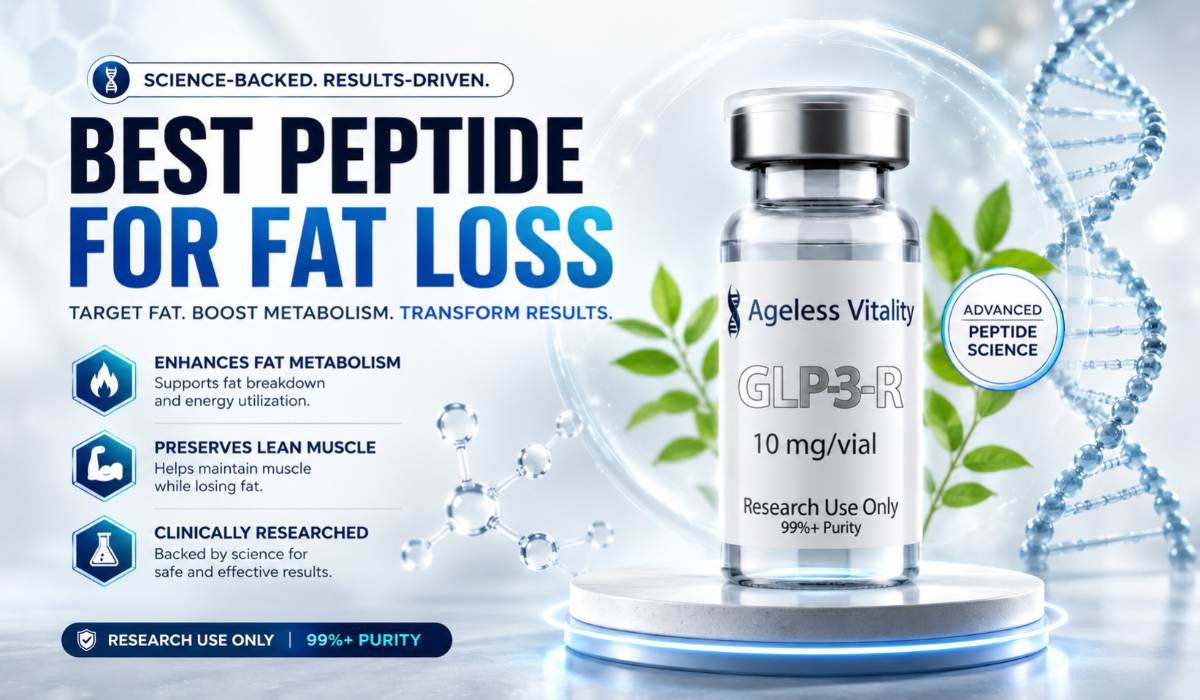
In longevity-focused labs specifically, this translates to research examining how peptide compounds interact with mitochondrial and energy-regulation pathways at the cellular level including NAD+, HCG, Tesamorelin, and the proprietary GLP-class compounds GLP-1 S, GLP-2 T, and GLP-3 RT. Labs comparing GLP-class research compounds may find our GLP-class compound comparison helpful, and researchers focused on fat-metabolism pathways can reference our best peptide for fat loss overview.
Regenerative Research Categories
Regenerative research categories encompass peptides studied for their potential role in cellular renewal and recovery processes an area that sits at the intersection of the signaling, structural, and metabolic categories above rather than as a fully separate class. Researchers in this space are typically interested in how peptide compounds influence the cellular conditions associated with regeneration, using model systems to isolate and observe specific mechanisms rather than whole-organism outcomes Epithalon and IGF-1 LR3 are two compounds commonly sourced for this integrative category. Because this category overlaps heavily with the other three, most longevity research programs treat it as an integrative lens rather than a standalone research track.
How Longevity Peptide Research Is Conducted
Longevity peptide research is conducted primarily through preclinical model systems in vitro cell cultures and animal models combined with strict handling protocols and detailed documentation practices that allow results to be verified and reproduced. The methodology prioritizes controlled variables at every stage, since even small inconsistencies in handling or record-keeping can compromise a study’s findings.
Preclinical Research Models
Preclinical research models are the primary tools used to investigate the activity of longevity-related peptides before any consideration of later-stage research phases. In vitro models cell cultures isolated in a lab environment allow researchers to observe how a peptide interacts with specific cellular pathways under tightly controlled conditions. In contrast, animal models provide insight into systemic effects across a living biological system. Longevity research, in particular, relies heavily on model systems that exhibit measurable aging markers, since these provide a consistent baseline against which to compare as a study progresses.
Laboratory Handling and Storage Considerations
Laboratory handling and storage directly affect a peptide’s stability, which is why research protocols typically specify controlled temperature ranges, protection from light exposure, and minimal freeze-thaw cycling for stored samples. Peptides are structurally sensitive compounds improper storage can lead to degradation that alters purity and, by extension, invalidates any results generated from that sample. Most research-grade peptides are shipped and stored in lyophilized (freeze-dried) form, as this state offers significantly greater stability than a reconstituted solution. Labs follow supplier-specific storage guidance to preserve integrity until the compound is needed for a given protocol. For researchers evaluating how storage timelines are typically documented, our notes on GLP-3 RT stability duration walk through that kind of record-keeping in more detail.
Documentation and Reproducibility in Peptide Studies
Documentation and reproducibility go hand in hand in peptide research: a study’s findings have scientific value only if another lab can follow the same protocol and obtain comparable results. This means researchers typically log batch-specific COA data, storage conditions, model system details, and observation methods alongside their results, creating a paper trail that ties outcomes back to a verifiable set of inputs. In a research landscape where peptide-related publications have grown into the tens of thousands over the past two decades, documentation standards are increasingly what separates findings that hold up under peer review from those that don’t.
Comparing Research Peptide Categories
Comparing research peptide categories means evaluating how signaling, structural, metabolic, and regenerative peptide classes differ in molecular composition and research application not ranking one category as more effective than another. Because these categories overlap in practice, comparison is most useful as a framework for narrowing down which class fits a given study’s objectives, rather than a strict either-or decision.
Structural Differences Between Peptide Classes
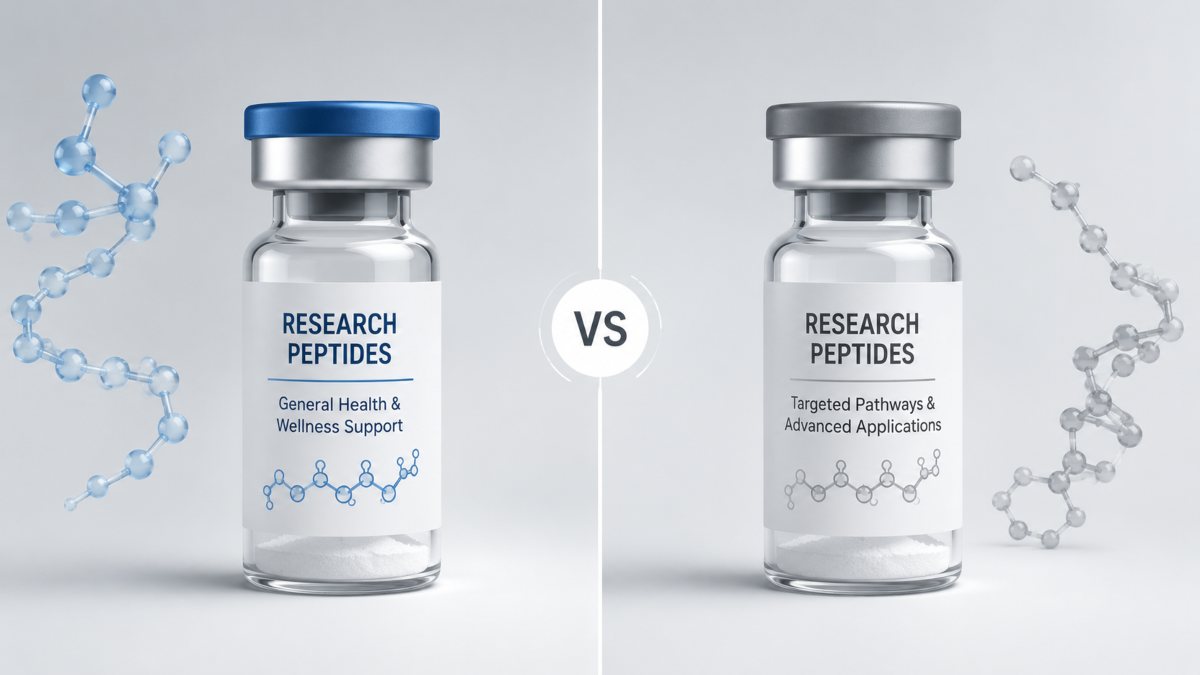
Structural differences between peptide classes stem from amino acid sequence length, chain configuration, and the specific receptor or protein targets each compound is designed to interact with. Signaling peptides tend to be shorter chains optimized for receptor-binding specificity. In contrast, structural and repair-focused peptides are often studied for their interaction with larger protein complexes involved in tissue architecture. These structural distinctions matter in a research setting because they directly influence how a compound behaves in a model system a signaling peptide and a structural peptide won’t be evaluated using the same assay or observation method, since they’re built to interact with entirely different biological targets.
Research Focus Areas by Category
Research focus areas vary meaningfully by category: signaling peptide research tends to concentrate on receptor interaction and cell communication pathways, metabolic peptide research centers on energy regulation and mitochondrial function, structural peptide research examines tissue and connective matrix processes, and regenerative research typically integrates findings across all three. This divergence in focus is reflected in the broader peptide literature a bibliometric analysis of peptide drug research from 2005 to 2024 shows that metabolic and structural applications are among the most heavily studied categories in the field, alongside oncology-focused peptide work. For a lab designing a longevity study, understanding which focus area a peptide class belongs to helps clarify what kind of data that category is actually equipped to produce.
Choosing a Research Category Based on Study Objectives
Choosing a research category should start with the study’s core question, not the peptide itself a project investigating cellular communication breakdown points toward signaling peptide research, while one focused on tissue degradation points toward structural and repair-focused compounds. Metabolic pathway research aligns with studies centered on energy regulation or mitochondrial decline, while regenerative research aligns with studies that span multiple mechanisms simultaneously. Framing category selection around study objectives rather than a specific compound’s reputation keeps the research design grounded in the actual scientific question being asked.
Research Considerations for Sourcing Longevity Peptides
Sourcing longevity peptides for research responsibly comes down to three things: verifiable documentation, clear research-use-only positioning, and a supplier whose practices hold up to scrutiny before a compound ever reaches the lab. Getting sourcing right at the outset saves researchers from discovering purity or compliance issues mid-study, when correcting them is far more costly.
Evaluating a Research Supplier’s Documentation Practices
Evaluating a supplier’s documentation practices starts with checking whether Certificates of Analysis are batch-specific and independently verified, rather than generic or self-reported. A supplier that provides current, third-party COAs for the exact lot being purchased demonstrates a testing process that can be verified, while one that offers only a standard purity claim without batch-level backing asks researchers to take that claim on faith. Beyond COAs, documentation practices worth reviewing include how a supplier handles storage and shipping records, as these details affect whether a compound’s condition on arrival matches the conditions tested. Our comprehensive research guide to peptide sciences covers this evaluation process in greater depth for researchers building a sourcing checklist.
Research-Use-Only Compliance Considerations
Research-use-only compliance means confirming that a supplier explicitly positions its peptides for laboratory research only, with no framing that implies the products are suitable for human use, diagnosis, treatment, or prevention of any condition. This isn’t a minor labeling detail RUO status reflects the supplier’s regulatory posture and, by extension, the researcher’s own compliance standing when sourcing from that supplier. A credible research supplier will state RUO terms clearly across product pages, documentation, and packaging, rather than burying that language in fine print or omitting it entirely.
What to Look for Before Selecting a Research Peptide Source
Before selecting a research peptide source, it’s worth evaluating the supplier’s consistency across three areas: documented batch-level purity, clearly stated research-use-only terms, and a track record of stable, verifiable sourcing rather than one-off availability. Peptide research published between 2005 and 2024 spans tens of thousands of studies across dozens of countries, and the labs contributing to that body of work depend on suppliers whose compounds behave predictably from batch to batch inconsistent sourcing introduces variability that undermines a study before it even begins. Treating supplier evaluation as part of the research design rather than a separate procurement step tends to yield more reliable results down the line.
Frequently Asked Questions (FAQs)
What does research-grade mean for a longevity peptide?
It means the compound has been manufactured to a documented purity standard and verified by methods such as HPLC and mass spectrometry, with that data available to confirm the peptide matches its labeled identity and concentration not a marketing claim without backing.
What’s the difference between research-use-only (RUO) and clinical-grade peptides?
Regulatory bodies haven’t evaluated RUO peptides for human use and aren’t intended to diagnose, treat, cure, or prevent disease. They’re supplied solely to support laboratory and preclinical research, which is a distinct regulatory and practical category from clinical or pharmaceutical peptides.
What purity level should researchers look for?
A purity level of 98% or higher, as determined by HPLC analysis, is the commonly referenced benchmark in the research peptide field. Lower purity introduces more variability, since synthesis byproducts and degradation fragments can affect how a compound performs in a study model.
Why does a Certificate of Analysis (COA) matter?
A COA is the standard document confirming a peptide batch’s purity and identity. Independent third-party verification carries more weight than manufacturer-reported data, since it removes the inherent conflict of interest. Researchers should look for batch-specific COAs rather than generic or outdated reference documents.
What are the main categories of peptides studied in longevity research?
Four broad categories, organized by biological pathway rather than by individual compound:
- Cellular signaling (cell-to-cell communication and receptor interaction)
- Structural and repair-focused (tissue architecture and cellular scaffolding)
- Metabolic pathway (energy regulation and mitochondrial function)
- Regenerative (an integrative category overlapping the other three)
How is this research typically conducted?
Primarily through preclinical model systems in vitro cell cultures and animal models combined with controlled handling protocols and detailed documentation. Longevity research specifically tends to rely on model systems with measurable aging markers to provide a consistent baseline for comparison.
How should research peptides be stored?
Most are shipped and stored in lyophilized (freeze-dried) form, which is significantly more stable than a reconstituted solution. Protocols typically call for controlled temperature, protection from light, and minimal freeze-thaw cycling, since improper storage can degrade the compound and invalidate results.
Why does documentation matter so much in this field?
Reproducibility depends on it. A study’s findings only have scientific value if another lab can follow the same protocol using verifiable inputs batch-specific COA data, storage conditions, model system details, and observation methods all form part of that paper trail.
How should a researcher choose which peptide category to source?
By starting with the study’s core question rather than a specific compound’s reputation: cellular communication questions point toward signaling peptides, tissue degradation questions point toward structural/repair peptides, energy regulation questions point toward metabolic peptides, and multi-mechanism questions point toward regenerative research.
What should researchers evaluate before choosing a supplier?
Three things: whether COAs are batch-specific and independently verified, whether RUO terms are stated clearly (not buried in fine print), and whether the supplier has a track record of consistent, verifiable sourcing across batches rather than one-off availability.