
How Much Bacteriostatic Water to mix with 5mg of BPC-157?
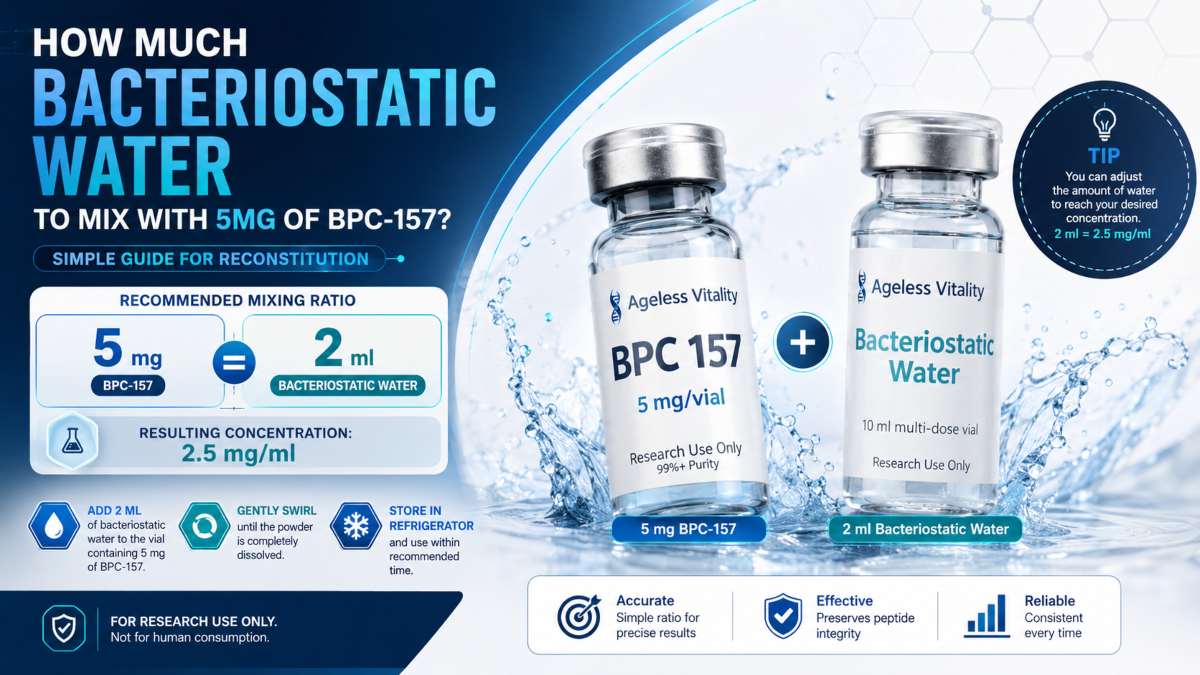
How much Bacteriostatic Water to mix with 5mg of BPC-157 vitals, plus proper storage guidelines for reconstituted research peptides. isn’t governed by a single fixed number the correct volume depends on the total peptide mass in the vial, the concentration a given research protocol calls for, and the total reconstituted volume the researcher intends to work with. Because these variables shift from one research setup to the next, no universal ratio applies across every BPC-157 5mg.
Bacteriostatic water itself is the standard diluent used in peptide reconstitution because its 0.9% benzyl alcohol content inhibits bacterial growth across multiple vial entries, which is why it’s specified over plain sterile water in nearly all peptide handling literature a distinction covered in depth in our guide on bacteriostatic water vs sterile water for peptides. Understanding how that diluent interacts with vial size, blend composition, and storage conditions matters more for research accuracy than any single fixed ratio and that’s the framework this guide walks through.
Understanding BPC-157 Reconstitution
Reconstitution is the process of converting a lyophilized (freeze-dried) peptide back into a liquid state so it can be measured and handled in a research setting. For BPC-157, this means introducing bacteriostatic water into the sealed vial, allowing the powder to fully dissolve, and producing a stable solution that maintains the peptide’s structural integrity throughout the research protocol.

What Reconstitution Means in Peptide Research
In a research context, reconstitution isn’t simply “adding water” it’s a controlled step that determines how usable a peptide sample remains over its working life. A poorly reconstituted vial can introduce inconsistencies in concentration from one draw to the next, which undermines the reliability of any research built on it. This is why bacteriostatic water, rather than plain sterile water, is the standard diluent: its preservative content allows the vial to be safely accessed multiple times without the risk of microbial contamination that plain sterile water carries once a seal is broken.
For a broader look at this process across peptide types, our guide on how to reconstitute peptides covers the foundational steps that apply regardless of which compound is in the vial. Getting this step right is foundational to everything that follows from how long the solution remains viable to how consistent the research itself is.
Why This Page Doesn’t Publish a Fixed Ratio
There’s no single bacteriostatic water volume that applies to every BPC-157 vial, which is why this guide doesn’t publish a single fixed number. The right volume depends on the total peptide mass listed on that specific vial, the total reconstituted volume a given research protocol calls for, and the resulting concentration that protocol requires three variables that differ across vial sizes, blends, and individual research designs.
A ratio that’s appropriate for one protocol can be meaningfully wrong for another, so rather than presenting a generic figure that may not apply to your specific vial, this page focuses on the variables that determine the correct volume for your particular setup, along with the handling and storage practices that affect the solution once it’s prepared. Our dedicated walkthrough on how to reconstitute peptides with bacteriostatic water delves deeper into the mechanics of the process.
Factors That Influence Bacteriostatic Water Volume
The volume of bacteriostatic water a BPC-157 vial requires is determined by three interacting variables: the peptide mass in the vial, the concentration specified by a given research protocol, and the total liquid volume that concentration corresponds to. Because these variables move independently of one another, two vials with identical labels may require different handling depending on how the resulting solution will be used.
Vial Size and Total Peptide Content
The starting point for any reconstitution decision is the total peptide mass listed on the vial, since this figure anchors every downstream calculation a researcher makes. A vial isn’t just “5mg” or “10mg” in isolation that mass has to be matched against the intended use volume, and the same mass can support meaningfully different concentrations depending on how much diluent is introduced.
This is why vial size alone doesn’t dictate a fixed water volume; it’s one half of an equation that’s only completed once the target concentration is known. Researchers working with larger formats such as a retatrutide 10mg will encounter the same principle: more peptide mass doesn’t automatically mean more water, it means the concentration calculation has a larger numerator to account for.
Why Concentration Varies by Research Protocol
Concentration is the variable that actually determines How Much Bacteriostatic Water to mix with 5mg of BPC-157 is present in a given vial, and it varies depending on the specific research protocol being followed. A protocol designed around smaller, more frequent measurements typically calls for a different concentration than one built around larger, less frequent draws and since concentration is simply peptide mass divided by liquid volume, changing either side of that relationship changes the correct water volume.
This is the core reason a single published ratio can’t be applied responsibly across all research use cases: the “right” volume depends on the protocol, not a fixed property of the peptide itself. For a real-world illustration of how these variables interact, our piece on how long 10mg of retatrutide lasts walks through similar concentration-based thinking applied to a different compound.
Single-Vial vs BPC-157 + TB-500 Blend Considerations
Reconstitution looks different when BPC-157 is the only peptide in the vial versus when it’s combined with TB-500 in a blended formulation. In a single-peptide vial, the total mass and target concentration belong to one compound, making the calculation more straightforward. In a blend such as the BPC-157 + TB-500 10mg blend the vial contains two distinct peptide masses that must dissolve into the same liquid volume, which means the resulting concentrations must be considered for each compound independently rather than treated as a single combined figure.
Researchers who want to understand TB-500 as a standalone compound before working with blended vials may find that context useful before introducing any diluent, since it affects how the solution’s composition is interpreted once reconstituted.
General Reconstitution Technique
The technique used to reconstitute a BPC-157 vial matters as much as the volume of bacteriostatic water involved, since careless handling can compromise a sample regardless of how the concentration was calculated. Good technique centers on controlling temperature, pressure, and contact points so the peptide dissolves cleanly without unnecessary stress on its structure.
Equipment Researchers Typically Use
Standard peptide reconstitution in a research setting relies on a small, consistent set of equipment: a sterile syringe appropriate to the vial size, an alcohol swab for disinfecting the vial’s rubber stopper before each entry, and a sealed bacteriostatic water vial. Some researchers also use a vial stand to keep the peptide vial upright and stable during preparation. The consistency of this equipment matters more than its sophistication using the same sterile, single-use components each time reduces the risk of introducing contaminants into a vial that may be accessed repeatedly over its working life.
Introducing Bacteriostatic Water Into the Vial
The general principle when introducing bacteriostatic water into a peptide vial is to add it gradually and gently rather than all at once. Directing the stream along the interior wall of the vial, rather than directly onto the lyophilized powder, helps the peptide dissolve evenly, preventing clumping or foaming. Swirling the vial slowly afterward never shaking it supports full dissolution while protecting the peptide’s molecular structure, since vigorous agitation can degrade sensitive peptide bonds. This guide focuses on these handling principles rather than a specific volume; for the complete step-by-step process, see our full guide on reconstituting peptides with bacteriostatic water.
Common Technique Errors to Avoid
A few handling mistakes account for most reconstitution problems researchers encounter. Shaking the vial to speed up dissolution is the most common, and it’s also the one most likely to degrade the peptide rather than simply mix it. Reusing a needle across multiple vial entries is a second frequent error, since it raises contamination risk with each additional puncture. A third is failing to let the solution rest briefly after swirling, which can leave undissolved particulate that affects the consistency of later measurements. Avoiding these three issues addresses the majority of preparation-related variability researchers report in handling peptide solutions and the same discipline applies whether you’re working with BPC-157, sermorelin, or any other lyophilized compound.
Storage & Shelf Life After Reconstitution
Once BPC-157 has been reconstituted with bacteriostatic water, storage conditions become the primary factor in determining how long the solution remains viable for research use. Refrigeration is the standard approach, and most peptide manufacturers report a reconstituted shelf life of several weeks when stored consistently at refrigerated temperatures though this varies by manufacturer and formulation, so check the specific guidance for your vial. For more on the diluent’s own shelf life, our guide on how long bacteriostatic water lasts is a useful companion read.
Refrigerated Storage Windows
Reconstituted BPC-157 should be kept refrigerated between uses, typically at standard refrigerator temperatures rather than in a freezer. Cold storage slows the natural degradation process that begins as soon as the peptide is in liquid form, extending the window during which the solution remains suitable for research use. Researchers should avoid placing the vial in the coldest part of the refrigerator, such as directly against the back wall, where temperatures can fluctuate or dip low enough to affect solution stability. Consistency matters more than precision here a vial that’s refrigerated reliably will generally outlast one that moves in and out of cold storage repeatedly.
Room-Temperature Stability
Reconstituted BPC-157 is markedly less stable at room temperature than under refrigeration, and most guidance recommends limiting room-temperature exposure to short, incidental periods rather than ongoing storage. Brief exposure for example, during a single research session typically doesn’t meaningfully affect the solution, but extended time outside refrigeration accelerates degradation and shortens the usable window described above. Researchers working in warmer environments should be especially attentive to minimizing the time a reconstituted vial spends unrefrigerated. This stability dynamic is common across the peptide category compounds like epithalon and thymosin alpha-1 follow similar post-reconstitution storage principles.
Signs Reconstituted Material Has Degraded
A reconstituted peptide solution that has degraded often shows visible changes before anything else: cloudiness, discoloration, or visible particulate in a solution that was originally clear are the most common indicators. A change in clarity is generally the most reliable early sign, since a properly reconstituted and well-stored solution should remain visually consistent throughout its usable life. If any of these changes appear, the solution should not be considered reliable for continued research use, regardless of how much time has technically elapsed since reconstitution.
Frequently Asked Questions (FAQs)
How long does reconstituted BPC-157 last?
Reconstituted BPC-157 typically remains viable for several weeks when stored consistently under refrigeration, though the exact window depends on the specific vial and manufacturer guidance. Solutions kept at stable refrigerator temperatures generally outlast those exposed to temperature fluctuations or repeated handling, so consistent cold storage is the single biggest factor in maximizing usable shelf life. For more detail on the diluent side of this equation, see our guide on how long bacteriostatic water lasts.
Can BPC-157 be reconstituted at room temperature?
The reconstitution process can be performed at room temperature without issue, but the resulting solution should be moved to refrigerated storage promptly afterward. It’s the storage phase not the act of reconstitution that raises concerns about room temperature, since prolonged exposure outside refrigeration accelerates degradation and shortens the solution’s usable window.
Does the TB-500 blend require different handling?
A BPC-157 + TB-500 blend involves two distinct peptide compounds dissolved in the same volume, so researchers should account for each compound’s mass and concentration separately rather than treating the vial as a single combined value. Beyond that distinction, general handling principles gentle introduction of bacteriostatic water, swirling rather than shaking, and prompt refrigerated storage apply the same way to blended vials as they do to single-peptide vials.
What other peptides are commonly researched alongside BPC-157?
BPC-157 is frequently studied for its role in recovery and tissue support. Researchers interested in adjacent areas of the peptide literature may also explore compounds such as GHK-Cu for skin and wound-related research, IGF-1 LR3 for muscle and growth factor research, or the CJC-1295 + Ipamorelin blend for growth hormone secretagogue protocols. Our peptide sciences research guide provides a broader overview of how these compounds are categorized and studied.


